Kentucky Wildcats, Mega Millions, and Jesus

April 2, 2012

I’m pulling out an old posting today from a few years back, but just changed the information to fit with this years winner, the Kentucky Wildcats.

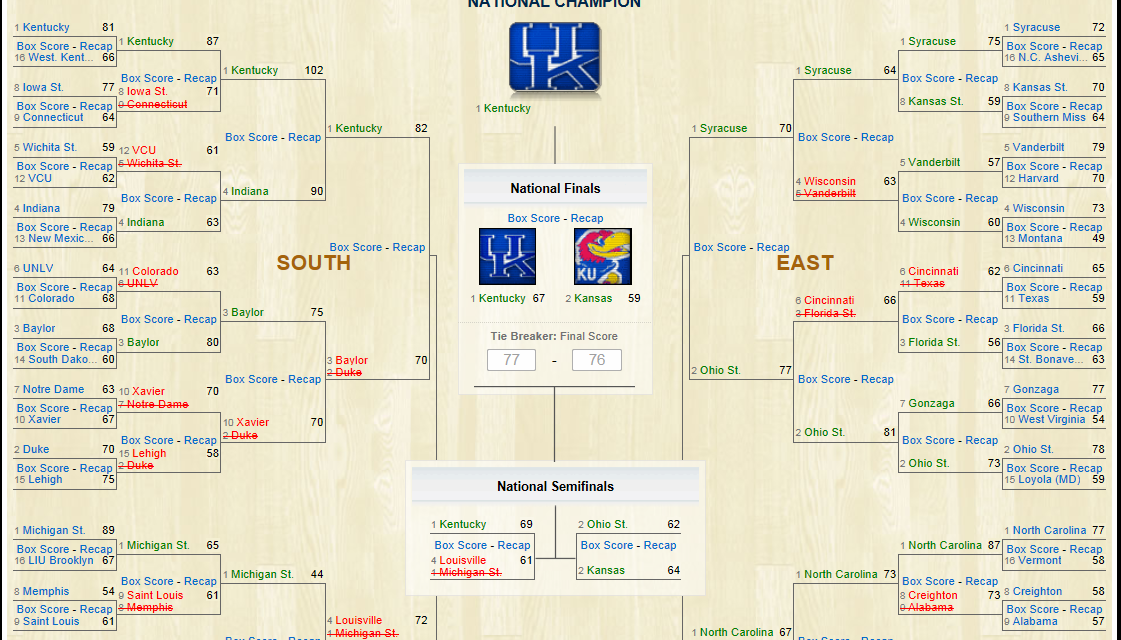
Well congratulations to Kentucky for winning their 8th national championship in basketball.  How did you do, our your brackets this year? Did you enter into any contests or competitions with friends? A few of the other youth pastors and I had a group and had a good time talking smack to each other. This year I picked 41 out of 63 possible games, had 3 of the final 4 teams in my bracket and picked Kentucky to win it all.  Pretty stupid considering that I didn’t watch a single college basketball came all season.

Every time March Madness rolls around I can’t help but to think about Jesus and the prophecies in the Bible. There is a lesson to be learned in the odds and mathematics of both the NCAA tournament and with Jesus fulfilling prophecy Here’s what I mean:

According to BookofOdds.com the odds of picking every single game in the tournament correctly are 1 to 35,360,000,000.  This is why some of the companies, like Dr Pepper and Yahoo.com, can afford to create excitement by offering a 1 Million Dollar prize if you enter and pick every single game correctly. It’s all about the odds for them and the money involved.  Playing the lottery has better odds in most cases.  Recently the MegaMillions Lottery had reached the highest it had ever been at an estimated 640 million dollars.   According to the official odds you had a better chance at winning the Mega Millions lottery because the odds at picking it were 1 to 175,000,000.  Much less than the NCAA brackets.

Well now that brings us to Jesus and the Old Testament prophecies about the Messiah. There are over 60 prophecies about this promised Messiah and details of His birth, birthplace, life, death, teachings, His nature, His resurrection, and events after burial, just to name a few. All these are documented in Josh McDowell’s foundational book called “Evidence That Demands A Verdict” or His updated version “The New Evidence That Demands A Verdict” (chapter 8, pages 164-202) Josh McDowell was an atheist who set out to disprove Christianity and the resurrection of Jesus Christ, but as he searched for answers he found out through his discoveries that indeed there was one true living God.

In McDowell’s reasearch he brings into the light the work of Peter Stoner in his book Science Speaks. Stoner does a great job at the probability and statistical mathematics of Jesus and fulfilled prophecy. Stoner took just 8 of the probabilities of the Jewish Messiah and figured out the odds at which Jesus or anyone would fulfill them. He came up with a rather large number. The odds were 1 in 10 to the 17 power. That would be a 1 with 17 zero’s after it. [1,00,000,000,000,000,000 ] Stoner gives a great visual example of that number, because it is so big and hard for us to wrap our minds around. Imagine that you fill the entire state of Texas with Silver Dollars 2 feet high. You mark one Dollar with an “X” and then blindfold a man and have him take one guess and find the one dollar with a “X” on it. Keep in mind that this is only 8 of the prophecies and not the entire lot. Stoner’s research has been examined for years now and the mathematics in his work has been found to be solid.

Well, where do we go from here? Let me just encourage you whether you are a believer or not, to take a closer look at the life and teachings of Jesus Christ. I am quiet sure you will see something different with Him than with any other religious leader in the world. There is a difference with Jesus because He was who He claimed to be, God.

As always your comments, questions, snide remarks are welcome.


Evolution of Trial: Gene Flow Take the Stand

April 1, 2012

Since the Supreme court was in the news recently with ObamaCare I figured I would use the analogy with the next few posts on Evolution and show how the evidence and facts don’t make good witnesses in a case defending Evolution.  The first witness that we will put on the stand will be Gene Flow.

Gene flow is the transfer of genetic material between separate populations. Many organisms are divided into separate populations that have restricted contact with each other, possibly leading to reproductive isolation. Many things can fragment a species into a collection of isolated populations. For example, a treacherous mountain pass may cut off one herd of mountain goats from another. 1  Gene Flow is a process that describes how the genes are keep local or spread from different plants and animals of the same family.

Gene Flow is often refered to in the human population and see by very easily in America especially in the large metropolitan areas where there is a highly diverse population of people from different areas of the world.  You can see the beautiful combinations of skin colors from the different people who get married and have children.

For example if a missionary’s family were to move to a remote location in a different part of the world and their family slowly is mixed through generations into the local population.  You might see skin color changes, height and weight changes, facial features or other features of the local population.  The same can be said of other plants and animals that would be closed off from others.  If Gene Flow is restricted you will see a population become less and less diverse because the amount of available information from the total Gene Pool is mixed in with the smaller population.   The Gene Pool just represents the total number of possible alleles (pairs of genes) for that particular chromosome within a family or species.

The human Gene Pool contains a massive 40,000 different varieties of genes that can be mixed in many different combinations within the 46 chromosomes we have.  If this is confusing to you, I suggest getting a deeper look at Gene Flow and the other terms online or in a simple biology book.   I will be looking at genes and the science over the next few posts.

Now that we have a basic knowledge of Gene Flow and the Gene Pool lets look at why it makes a poor witness on the stand defending evolution.  No matter how much the gene’s “flow” it will not ever produce new genetic material.  In the above examples with goats and humans, in all the cases the goats are still goats, and the people still people.  This all fits into the umbrella of micro-evolution or adaption.  There are no invertebrates that become vertebrates, or amphibians that become reptiles.  Gene Flow of this type has never been seen or accomplished with a lab.  The DNA will not allow it.

What about Hybrids?  Someone might respond with the examples of the Liger (Lion and Tiger) or another type of hybrid.   These type of examples of Gene Flow are so rare that they do not affect the total population of a genus and do not survive in the world without human intervention by care in a zoo.  There are no known hybrids between different genuses, only between sub-species like a  Bengal tiger and Siberian tiger.  A hybrid of goat and sheep for example that are closely related, but when they mate the children are usually still-born and if they survive they are always infertile. 2   People have experimented with different types of hybrids in the labs, but when left in the wild the animals do not choose to mingle.  These hybrids would fall more into the area of mutations and we will look at that witness on the stand in an upcoming post.

One possible rebuttal that someone might give you defending evolution is that “given enough time over millions and millions of years these little changes add up to changes in genuses and new genetic material is born.”  This is false, because if no new genetic material can from within a short-term, then the same is expected with the long-term.  Time is a distraction here and has nothing to do with the process of Gene Flow and Genetic Drift.

For example: 0+0+0+0 = 0 and at the same time 0+0+0+0+0+0+0+0+0+0+0+0+0+0+0+0+0+0+0 = 0

According to Genesis 1:24 “And God said, “Let the land produce living creatures according to their kinds: the livestock, the creatures that move along the ground, and the wild animals, each according to its kind.” And it was so. “  God created the animals separately.  I realize that we can’t view the creation story just like we can’t observe evolution in the past, but according to the evidence we do have about plant and animal life now, you have to honestly ask yourself what does the evidence we do have now support?  We will cover creation in later blogs.  As always questions, comments, and discussions are welcome.

References:

1 – http://www.answers.com/topic/gene-flow#ixzz1pcMgvfea

2. – http://www.answers.com/topic/sheep-goat-hybrid

3.  – Sherrod, Chris; Faith, Fact, and Reason: Study #5 The Flaws of Evolution pgs. 75-76


Defining Terms: Presupposition

March 22, 2012

dictionaryA hard word to say, but not that hard to understand.   It sounds like a disease to me,  I hope it’s not contagious.   According to Merriam-Webster,  Presupposition: is to suppose beforehand or to require as an antecedent in logic or fact.  Using it in a sentence,  I might say; “Before you read my blog, my presupposition is that you like to learn about apologetics.” or “It is a presupposition that you don’t have a problem seeing blood if you are going to be nurse.”

In apologetics there are many presuppositions that both sides have when it comes to debates and conversations.  For example as a Christian after I have examined and study the Bible, I have a presupposition that the Bible is inspired by God and that it is trustworthy and valid.  I have a presupposition that miracles are possible and that God exists.  Someone else who takes an atheist position might have a presupposition that there is nothing within our universe that is not physical.

Presuppositions are often foundations that we set at the base of our knowledge and can add-on to our beliefs on top of our presuppositions.  Most of the time if a person has a presupposition, they have locked in their trust or belief in that presupposition and it is hard to move them away from what they have already come to find true for themselves.

However, if you really want to “put a pebble in someone else’s shoe” to make them think about their beliefs and worldview attacking their presuppositions are a great way to make some progress.  For example, if I were talking with a Mormon and I wanted them to see that Christianity is the one true worldview a good place to start would be to show the Mormon the faults, contradictions, and failed prophecies within the Book of Mormon and it’s leaders through history.  If I can show them that the book that they presuppose is true is false, then I have made significant progress in knocking down the pillars that support their Mormon worldview.

As I mentioned before that often times, someone will assume something is true based on their presupposition about a certain related subject, even without knowing that something in an absolute certainty.  I might read a difficult passage of scripture in the Bible, but because I have found the Bible to be trustworthy and reliable as a whole, I will take it for truth even if I can’t explain or understand it yet.  Both Christians and atheists alike must be careful not to let the cart come before horse in the formulating of their premise and conclusions based on their presuppositions.  You can quickly get into circular reasoning, which is a bad debate technique.

If you have any questions, comments, or examples you want to share, please feel free to leave comments.

Biography

1 – http://www.merriam-webster.com/dictionary/presuppose>


The Evolution of Evolution

March 21, 2012

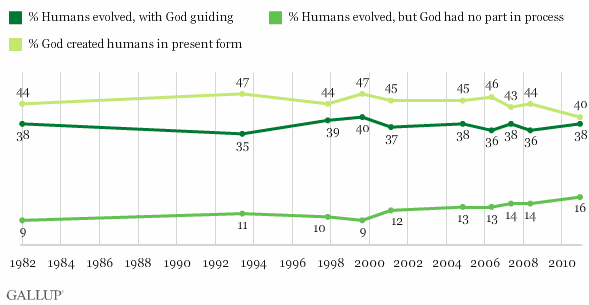
I want to spend a few posts examining the claims of evolution and breaking it down piece by piece, but before I do that I want to give you a basic understanding of what evolution is and how it has changed over the years.  Evolution is one the most popular alternative answers to the question of where did we come from, outside of a theistic of creation answer.  A 2010 gallop poll has shown that 40% of Americans believe in creation, 38% believe that a supernatural being created the world through the process of evolution, and 16% believe in a naturalist evolution without the help of the supernatural. 1

Evolution Belief ChartThe word evolution can mean different things depending on who is using the word.  Evolution simply means a change over time.  People often speak of the evolution of a certain model of car or how computer technology has evolved.  Most people think about the evolution in biology when they hear or use the term.  When you discuss evolution it is important to understand the distinction between two different types of evolutionary.  Micro-Evoluion where minor changes within a species (family group) occur, but do not give rise to new gene material.  I call this type of evolution adaptions.  We see this everyday within varieties of plants and animals such as dogs, frogs, garden vegetables, and trees for example.  Macro-evolution is  larger scale change from species (family group) to another species (family group) that is more complex and higher through mutation and natural selection.  No one has ever witnessed this type of evolution before and this is the type of evolution that is claimed through Darwin’s theory.  From this point forward, when you see the word Evolution, it will refer to Macro-Evolution.

Evolution is a purely physical/naturalistic explanation to the origin of life on earth and of all matter in the known universe.  Charles Darwin has been known as the Father of evolution, but he wasn’t the first to contemplate a purely physical origin, during the fourth and fifth centuries some Greek philosophers like Thales, Leucippus, and Democritus had detailed explanations of how the universe came together through random forces rather than by design. 2  Darwin also had a partner, Alfred Wallace, who worked with Darwin on the theory of evolution, but Wallace began to doubt it was adequate to explain obvious features of the human race.  You don’t hear much of Wallace and His disagreement with Darwin now.

About 30 years ago the theory of Evolution begin to be looked at more closely by public and private school systems  because of the rise of Christian apologists in the mid-century that began to challenge the views of Evolution.  Parents and school boards had Evolution taken out of school textbooks or demanded that other textbooks that taught other ideas like Intelligent Design as equally as Evolution to be used.  This seem to waken those who supported Evolution like Dawkins, Hawking, Dennett, and Harris, to push back even harder with newer evidences and proofs with the new advancements that science was making recently.  Many of these newer evidences are published in scientific journals, books, web blogs and are used by many highschool and university teacher to continually bombard students through indoctrination.  Most of the scientific claims today that are labeled “support for Evolution” are speculative at best, leaving the majority of the proof on assumptions and premises.  They are lean on supporting facts and rely on your presuppositions and how you interpret the data.  I can back up that last thought with the evidence that despite all this “new” evidence for Evolution the debate still wages on.  The case had not been closed in the slightest.  Open-minded intelligent theists are not abandoning their beliefs in support of evolution.  You can reference this in the Gallop chart.

The New Atheists have been on the offense as of late to attempt to snuff out any religious beliefs by Christians. Their words towards religious beliefs have been harsh.  Richard Dawkins has even had a college circuit speaking tour where has offered a debaptizing ceremony for those who wish to renounce their faith in God. 3  The boldness at which these new claims are being made by those who support Evolution is very high.  It reminds me of the axiom, that “the bigger and more important the lie, often the greater the enthusiasm of which it must be sold with.”  Not to worry though, because there are a new group of well-educated Christians in both the field of science and philosophy that have risen to the challenge by the New Atheists.

Over the next few posts I will examine Evolution  and break down the processes and talking points that many supporters of Evolution use to champion their beliefs.  Evolution must account for three “Big Bangs;” the origin of matter, the origin or life, and the origin of our consciences.  We will also look at the processes like genetic drift, gene flow, mutation, non-random mating, as well as natural selection.  If you don’t understand those words, don’t worry I will explain them to you one at a time in future posts.  If you support evolution and have something you want me to look at please leave a comment here and I will add it to the list of topics of discussions with Evolution.  I will do my best to give you an accurate view of Evolution, I don’t want to try to make any red-herrings out of the other side of the argument.  As always your questions, comments, and discussions are welcomed.

Biography

1 – http://www.gallup.com/poll/21814/Evolution-Creationism-Intelligent-Design.aspx

2- Sherrod, Chris – Fact, Faith, and Reason Study #5 The Flaws of Evolution, pg. 27

3 – Marrow, Jonathan; McDowell, Sean – Is God Just A Human Invention?


It’s My Pleasure

November 18, 2011

I love Chic-Fil-A.  I love the food and the company and what they stand for.   Across from my church where I serve as student minister is a Chic-Fil- A that I visit at least once a week, not counting the stops for coffee in the morning.  Over the years I have gotten to know the people who work there and build some relationships with the people.  Our church even opens up the church for Colby and the leadership team to meet about every two weeks.   The church staff has nick-named the Chic-Fil-A across the street “The Birthing Place” because we also use their store to have meetings with people over a coke or lunch.  We share Christ with people outside the church walls and some are “born” into a new relationship with Christ there.  Well, if you have been to a Chic-Fil-A in the last 3-4 years you know that their signature saying is “It’s my pleasure!”  It was something the company started several years back and has stayed with them since.  It shows a willingness to serve the customer and it not just words from what I have witnessed over the years, it is something that they employees model.

One day a few weeks ago I was in my thinking mode and I had a thought about their phrase and what might be the impact of the customers because of it.  What is it saying to the customer?  I know that it is a way that Chi-Fil-A is trying to make the dinning experience more enjoyable and to make the customer want to come back.  They were not the first company to bring the idea to the public.  Years ago Burger King started their slogan “Have it your way.”  I remember a  time when businesses were not so forth coming with their service.  If you bought a milkshake and then your child spilled it on the floor you actually had to go buy another one yourself.  (GASP!!)  Imagine that?  You actually had to have a little personal responsibility.   It wasn’t long after one company started the extreme service that others had to follow, or be left behind.  What am I talking about?  In one word: Entitlement.

America has become a land of Entitlement.  Freedom has been translated into FREE!  People used to ask for things, now they demand them.  (Believe me I could tell you some stories!!)  Listening to the radio a few days ago, I heard the statistic that 47% of people in the United States don’t pay any federal taxes AND many of them get money from the government.  I could go back and give examples of the social welfare programs but I don’t want to bore you.  I will point out that while many people complain that their Social security is not much to live on, most of them will receive multiple times more than they paid into it over the years.  It’s not just the senior adults to.  We have raised a generation of young people who do not appreciate what they do have.  The year I graduated high school Georgia started a Lottery and a college scholarship program called HOPE.  If you had a 3.0 or higher GPA the state would pay 100% of your college tuition.  Earlier this year the state had to cut back on the moneys they were giving to keep the program alive.  They had to cut the 100% to 93%.  If your GPA was 3.8 or higher you still got 100% from the state.   People protested in front of the capital, they were interviewed by TV and Radio and you would have thought that they had closed all the colleges up and their was no way they could go to college now.

Two months ago another chapter in the Entitlement book was being written, this chapter is called Occupy Wall Street. Groups of people gathered on Wall Street to protest cooperate greed, and a few hundred other things they didn’t agree with.  Soon the movement spread throughout cities around America as they began to occupy parks in cities everywhere.   The news coverage has not been dull when occupy Wall Street comes up.  There have been a number of actions that I won’t get into except to name a few like, using the bathroom on an American flag and a police car, public nudity, public sex, violence and confrontations with police around the different cities, looting, rape, drug and alcohol abuse, and at this point one death in Oakland, CA.   I’ve only just scratched the surface with the list above.

So who are these people?  According to a survey of Zuccotti Park protesters by the Baruch College School of Public Affairs published on October 19, of 1,619 web respondents, 2/3 were younger than 35, half were employed full-time, 13% were unemployed and 13% earned over $75,000. 27.3% of the respondents called themselves Democrats, 2.4% called themselves Republicans, while the rest, 70%, called themselves independents.

On Oct. 10 and 11, the polling firm Penn, Schoen & Berland interviewed nearly 200 protesters. Half (52%) have participated in a political movement before, 98% would support civil disobedience to achieve their goals, and 31% would support violence to advance their agenda. Most are employed; 15% are unemployed. Most had supported Obama; now they are evenly divided. 65% say government has a responsibility to guarantee access to affordable health care, a college education, and a secure retirement. They support raising taxes on the wealthiest Americans, and are divided on whether the bank bailouts were necessary.

Radio talk show host Neil Bortz among others has pointed out that the vast majority of these OWS protesters are young and have not had a taste of the real world.  “They have been told” ” Neil continues “that they are all winners, and no one is a loser all their life.  There are no soccer game lossers, because we can’t afford to hurt their self-esteem.  Then when they get out of school and into the real world they revolt because nothing they have been told in life is true.”  He adds that they all have lap tops, smart phones, and the latest gadgets, but yet they claim they are poor.

There are a lot of lessons to be learned here.  We could talk about the prospective from which the “me” generation and how that if you live in America you are among the top 7 percent richest in the world.  They could sell their laptops and smart phones and help feed a family for a year in another country.  We could talk about the messy morality that this is an example of.  How the sinfulness and selfishness of mankind is running wild because people have abandoned the church and godly principles.

2 Timothy 3:1-4 says ” 1 But mark this: There will be terrible times in the last days. 2 People will be lovers of themselves, lovers of money, boastful, proud, abusive, disobedient to their parents, ungrateful, unholy, 3 without love, unforgiving, slanderous, without self-control, brutal, not lovers of the good, 4 treacherous, rash, conceited, lovers of pleasure rather than lovers of God— 5 having a form of godliness but denying its power. Have nothing to do with them.”  Sounds like it was written yesterday doesn’t it?

So how do you fight back against this Entitlement mentality?  Start by changing the way you personally entitle people around you.  It’s good to give someone something, but it’s even better to teach them to provide something for themselves.   It all starts with one.  Jesus told us that we will always have the poor with us on the earth, but if we start teaching people how to fish rather than giving them a fish the situation will turn around again.  Those that have can help take care of the smaller amount of those who really need help.   If you make a mistake, own up to it, be personally responsible for your own actions.  Don’t count on someone else picking up the tab for your mistake.  Vote, put people in office that will help control the growing problem of entitlement.   There are ways that we can slowly began to pull back on the throttle of entitlement that will still allow those that are receiving it now to ween themselves off part of what they get.

If you have any more suggestions or ideas please feel free to leave a comment.  As always, questions, comments, and discussions are welcome.

The Bible and Slavery

November 17, 2011

I recently had a conversation with someone about the issue of slavery in the Bible.  He expressed that it was one issue that kept him from believing that the Bible was inspired by God.   I thought I would use the conversation as a blog post and not let the research I have done go to waste.

I have heard other objections and questions on slavery before.  Some of the typical things said are; If slavery is objectively wrong, why would God allow it?  God command the Israelite people to take slaves.  Christians in the southern United States had slaves and used the Bible to justify their actions.  The Bible never says that slavery is wrong.   As I mentioned before in a previous post that most of these are Straw Man arguments that misrepresent the truth of the matter.   Here is what the Bible does say about slavery.

First, we must realize that slavery was not God’s original intent for mankind.  We see this in another issue that was raised to Jesus in Matthew 19:3-8.

Some Pharisees came to him to test him. They asked, “Is it lawful for a man to divorce his wife for any and every reason?”  “Haven’t you read,” he replied, “that at the beginning the Creator ‘made them male and female,’ and said, ‘For this reason a man will leave his father and mother and be united to his wife, and the two will become one flesh’?  So they are no longer two, but one. Therefore what God has joined together, let man not separate.”  “Why then,” they asked, “did Moses command that a man give his wife a certificate of divorce and send her away?” Jesus replied, “Moses permitted you to divorce your wives because your hearts were hard. But it was not this way from the beginning.

Perplexed by the first answer that Jesus gave them, they asked Jesus about the laws of Moses that concerned divorce.  Jesus response was to the heart of the issue and pointed to the source of the problem, the harden hearts of the people.  God’s original design was for no one to experience divorce, but since the fall and the sinful nature of man, God gave Moses rules to help protect the people involved in the divorce.  The same principle can be applied to slavery as well.  Slavery was not God’s original plan from the beginning, but because of men’s sinful nature, God gave rules to help regulate and protect those who were slaves.

Secondly, the Biblical idea of slavery is not the same as African slavery that most Americans think about.  Leviticus 25:25-55 outlines the laws that God set for Israel to follow concerning someone who owed a debt and could not pay it.  God allowed them to sell themselves voluntarily and work off their debt.  The person who bought them could only keep them for a maximum of 7 years and then they had to let them go free, regardless if the debt was paid off or not.   I won’t go into all the details you can read it for yourself, but God set rules up concerning slavery after it had already been in practice so that people would not be taken advantage of by others.  The first slaves in the Bible came from Ham, one of the sons of Noah.

Not only was Biblical slavery or being a bond-servant voluntary but we know that they were not treated like slaves in America or other parts of the world with the respect of harshness and physical violence.  Many of the slaves were treated just like family and friends.  They were given positions of leadership in the home over children and possessions.  The story of Joseph is a great example in Genesis 39.  Realizing that not everyone might not treat their purchased slaves as they should, God also set up laws concerning the treatment and protection of the slaves.   Deuteronomy 23:15-16 says “If a slave has taken refuge with you, do not hand them over to their master. 16 Let them live among you wherever they like and in whatever town they choose. Do not oppress them.”  This gave the slaves a way out of the arrangement if they were being treated unfairly.  In Exodus 21:16 God strictly forbid the kidnapping of an individual and selling them as a slave.  In the same chapter, God also declared that if even an owner hits a slave and damages as little as an eye or tooth, that the slave can go free and the debt is canceled.  As you can see this is vastly different from the African slavery that was practiced by those in America and other parts of the world.

The most popular verses that are used by those who argue against the Bible are found in Leviticus 25:44-48.

44 “‘Your male and female slaves are to come from the nations around you; from them you may buy slaves. 45 You may also buy some of the temporary residents living among you and members of their clans born in your country, and they will become your property. 46 You can will them to your children as inherited property and can make them slaves for life, but you must not rule over your fellow Israelites ruthlessly.  47 “‘If an alien or a temporary resident among you becomes rich and one of your countrymen becomes poor and sells himself to the alien living among you or to a member of the alien’s clan, 48 he retains the right of redemption after he has sold himself. One of his relatives may redeem him:

Those who argue against the Bible will use this verse claiming that God commanded or gave permission to Israel to take slaves from the other nations around them.  The way the words are used make it look like that is the intent, but the truth is the scripture is not taken in context and if you look at the surrounding text and the language you can come to the correct meaning.  First, God has just laid out the laws concerning treating their own countrymen as slaves and warned them to treat them not like a slave at all, because they are Abraham’s children.  When the scripture says that they may keep the slaves from another country for life, it only meant beyond the 7 years maximum because they were not part of the nation of Israel.  When the debt was paid off the slave could go free.    In verse 44, the word “come” literally translates from the Hebrew word meaning “that exist” this makes the implication of the verses read differently. It would appear that God was referring to the slaves they already had possession of.  To further add a nail in the coffin, when you look at this verse in context with all the other verses that we have examined you can’t interpret it as a command to take slaves, because God has already spoken against it.  The idea that scripture interprets scripture is in play here.

One last objection that I have recently heard was that if God was an omniscient God, He would have know how people would have misused God’s Word to defend and justify horrific versions of slavery, Why didn’t God say or do something to stop it by including it in the Bible.  Yes, he would know that men would pervert his original design for life, but the question I have is would God break the free will He gives to man to stop the horrific treatment of a slaves.  I believe the answer is No.  We do know that any one can twist the Bible to make it sound like it supports their point of view on an issue.  It is easy to take one verse or a group of verses and single it out to read like you want it to.  Unfortunately, the slavery that was practiced  by the Christians in the southern United States was wrong, and those who were Christians didn’t bother to look at what the word of God had to say about the issue.  They were wrong.   At the same time there were also many other Christians who knew that it was wrong and choose not to participate.  Truth be told in history, it was the Christians who sought to free the slaves in England and America.  A popular Christian minister, William Wilberforce was one of the ones leading the charge in England.

As always, questions, comments, and discussions are welcome.


Defining Terms: Irreducible Complexity

November 17, 2011

Before moving on to taking a closer look at Evolution I wanted to tie up some loose ends on a post I had over a few weeks ago I wanted to finish out some ideas of the Teleological Argument.  One of the main 2 components of Intelligent Design is the Idea of Irreducible Complexity or (IC) for short.

Irreducible Complexity – A single system composed of several well-matched, interacting parts that contribute to the basic function, wherein the removal of any one of the parts causes the system to effectively cease functioning.

A Mouse Trap is a great example of Irreducible Complexity.   I’m not talking about the more humane traps they have now, but the “old school” kind that consisted of a spring, a trigger, a hammer type bar, and a piece of cheese all mounted on a base.   You know what I’m talking about.  They provided endless amounts of laughter in movies where people stepped on them and got their fingers caught in them.  If you were to remove just one of the parts of the mouse trap it would not continue to function as a trap.  At the same time if you build a trap and leave off a part, it will also not work.  We can see from the design of the mouse trap that it has a specific design and it will only function properly when all the pieces are present and working together.

The mouse trap is relatively simple compared to other examples of (IC) that we can look at in life.  Below are some examples of Irreducible Complexity in biology.

The Eye – The eye is what caused Darwin to pause for a second in reviewing his own theory of evolution.  He could not see how the eye could have evolved given the fact that all 12 parts of the eye need to be present for sight.  If an eye were to start to evolve the individual parts would have to come about slowly over time and until each part was complete there would be no advantage until the whole eye was formed.  In other words there would be no need for an eye lid to grow if there was no eye, or there would be no lens if there was no pupal to connect it to.  Darwinian evolutionists have tried to compare other animal eyes that are less complex and show that they could have evolved from species to species, but have not made a solid case.

“The Simple Cell” and Bacteria Flagellum  – In my early days in biology we studied the “simple cell” and learned about the 8 basic parts that made up the cell.  Today, the simple cell has become not so simple.  There are 52 individual parts that make up the cell.   The cell functions like a super efficient delivery service company in the height of their Christmas season.  There are things moving around and through the cell all the time.   When a cell is missing one of the components the cell will cease to function.

Michael Behe, an Intelligent Design (ID) supporter has said “What we’ve discovered in a cell in the past half-century or so are quite literally molecular machines, machines of enormous complexity.  There are little machines in the cell that act as trucks and busses that take supplies from on side of the cell to the other.  And they use little signposts, and there are garage doors that open and shut to let the supplies into various compartments.”  Behe, continues to explain the parts of the ion powered rotary engines called flagella of certain bacteria.  They have similar parts of a motor like  O rings, Drive shafts, bushings, etc…  Absence of any of these parts would cause the bacteria not to function.  With a cell, it’s “All or Nothing.”

The Wing – How did the wing evolve?  Evolutionist say that it was to extend jumping or to slow falling.  – The complexity of the wing would have required thousands of positive mutations in order to change to the complex wing.  The instincts of the ground animal would also have to change to flying from walking or living in trees.

One of the criticisms of (IC) is because we don’t understand how things work or have come to function as a whole, doesn’t mean that we might not understand the science or biology in the future.  Science may in fact yield an explanation to one of the examples above, but that doesn’t mean that God does not exist.  It only means we have had a gap in the knowledge.  The new atheists have coined the phrase “God of the Gaps” for Christians who cannot explain something and just say that “God did it.”   As a Christian, I have no problem with giving credit to God for all explained and unexplained events.  God can surely created laws of science to build the universe within, but we must be careful to not try speak for God and explain things incorrectly.  We might end up eating our words after the passing of time.

As always, questions, comments, and discussions are welcomed.


Atheism and Morals

November 11, 2011

If  you missed the first blog about morals and God you can click here and read it if you want to gain an understanding of morals from a Biblical view-point.  In my second blog about God, Morals, and Atheism I want to talk about the way that atheism views morals.    I want to be careful to describe their view of morals correctly because then I want to test it with some questions. After reading books by atheists and talking with them this is what I have found in general about what they believe about morals.

Since most atheists ascribe to Darwin’s theory of evolution, it would not surprise you to find that they believe morals have evolved as well.   They use the example of animals that have a basic conscience that can show fear and shame with their actions.  One website explains “Morals are, basically, the rules by which our social groups function. They ensure that things are reasonably fair and that relationships run reasonably smoothly. Social groups simply wouldn’t survive without rules, so the evolution of the ability to create and follow rules should be expected.”   Atheists also claim that morals have evolved over time and this proves that moral evolution is true.  They claim that we no longer follow the morals of the Bible like slavery, treatment of women, and war.

From here there is a divide about how some atheists see the individual evolution of morals.  Some insist that morals as an individual trump the morals of a society.  Others see it the opposite way around that in order to survive as an individual, humans somehow find it in their best interest to work together as a society to survive.  In the late 19th Century most atheists seem to take the individual viewpoint of morals.  Atheist philosopher Friedrich Nietzsche remarks “Equality is lie concocted by inferior people who arrange themselves in herds to overpower those who are naturally superior to them.  The morality of ‘equal rights’ is herd morality and because it opposes the cultivation of superior individuals, it leads to the corruption of the human species.”   New atheists like Sam Harris who are seeking to find a naturalistic view of morals, look more toward the influence of the culture as to defining the morals of an individual.  In his book, The God Delusion, Richard Dawkins uses 4 main ideas that can create a cultural view of morality.  They are altruism, kinship, reputation, and fear of punishment/desire for reward.  But both Dawkins and Harris admit that natural will give little help in cultural morals because the individual will fight against other individuals.  There seems to be an evolution of the way things are explained as it comes to morals.  Others might call this a change of mind.

What about the claims of atheists?  Are we really not that much different from all the other animals?  Have morals changed from the times of the Bible?  How do morals evolve?  All that being said, these are some questions that I believe need to be answered and I have difficulties that I have found with the idea of evolutionary morality.  Here are a few thoughts.

1. Are humans really not that much different from the animals?  Darwinism would have you think not, but one look around at the world tells the real story.  Biologist have been experimenting with primates for years, trying to teach them sign language, teach them behaviors, and more, but the best that can be observed is a mimicking of human behavior for a short time for a reward.  Animals are still called the savage beasts for a reason.

2. What about the claim that morals have changed over time?  The idea that we are no longer the selfish individuals of the past or of the Bible?  One look at the last century will tell you that indeed we are not becoming more morally evolve.  The 20th century was the bloodiest centuries of in history.  David Berlinski, in his book The Devils Delusion, outlines all the wars that have been fought and the number of deaths that been as result.  The numbers are over 160 million total.  The Biblical view of slavery is a bit of a straw man argument and was never anything like the African slave trade of the recent century. There is still mistreat meant of women today, perhaps as much as there was in history.  Take a look at the issue of sex-preference abortions that take place in China and India because families don’t want a female child they will terminate the pregnancy in order to try to have a boy. Also just  take a listen to a few Hip Hop songs and you will understand what some people still think of women.  Since the rise of atheists in the 19th century, as far as evolving morals, I see things actually getting worse, not better.

3. How do morals evolve?  This is perhaps the biggest leap concern I have with evolutionary morality.  How does a cell produce thought, a conscience, or morals?  Naturalists who argue for evolution want to say the brain is so highly developed, which it is, and it gets to the point where conscience is born.  This is not the traditional view of the human mind and body that are separate and that the human soul exists separate of the body.   Atheists want to argue that some how, the matter created the mind.  They try to explain it with the complexity of the brain and the long time that has passed to allow slow changes to create a mind.  But, no matter how complex something is, or how much time might pass, cells don’t grow feelings, atoms don’t feel things.  Science has no explanation for this as of yet, perhaps they might in the future, but I doubt it.   There is more to add to the brain/mind discussion but I will save those for another post.

4. There is also another area in morals that has a wide range of thoughts by atheists.  It is the question, Are morals objective?  From a Biblical perspective the answer is an easy, yes.  The Christian worldview has no issues with objective morals or right and wrong because they come from a transcendent God who sent the standard.  On the atheist side of the coin there is wide debate between atheists.  If you ask an atheist whether Rape or child abuse, which is a current topic in the news with Penn State, is objective wrong, they will most likely say yes, it is universally observed as wrong.  They may however be hesitant to say yes because they cannot explain where this universal moral comes from.

I will address some other thoughts related to morals in the near future.  As always, questions, comments, and discussions are welcome.


Defining Terms: Strawman Argument

November 9, 2011

In my last post I used the phrase “Straw Man argument.” I wanted to explain what the term meant and give a few examples of it in apologetic discussions.  The term Straw Man fallacy can also be used interchangeability.

Straw Man Argument – Straw man arguments involve misrepresenting the view-point of someone else to make it easier to knock down.  This can be done by defining a term incorrectly, not presenting all the facts or view points that might be controversial, it can even been from out-right purposeful lying.

Apologist Chris Sherrod uses the example of a statement often made by Darwinian Evolutionists.  “You creations don’t accept the fact that evolution can be observed.”  Here the mistake is referring to the type of evolution that is described.  Macro Evolution vs. Micro Evolution.  Christians do see and support micro evolution, it is also called adaption.  What has never been observed is macro evolution where living organisms change species.

Just this afternoon I went to hear a man, who called himself an atheist, speak on the subject of America not being a Christian nation at it’s foundation.  During the question section of his time he began to talk about the Biblical view of slavery and how Christians have changed their view of slavery over time.  He made several comments hinting that God approved of slavery or that enslaving other slaves from other nations was commanded by God.    He told the group that there were verses in the Bible where God instructed them that it was okay to have slaves and even referenced the apostle Paul saying that Paul instructed the Slaves to obey their masters.   I saw the straw man argument that was being build up before my eyes.   At the proper time I spoke up and called the argument for what it was.  I told the man that he was misrepresenting the Biblical idea of slavery and that no where did God command the Hebrews to take slaves and make them their own.  When he said I was wrong, I asked him to produce the verse, and he could not.   I shared a few differences between Old Testament Slavery and the typical African slavery that many people think about today.  I didn’t want to take up his time with the students, so I quickly wrapped it up and we agreed to talk over email in the future.

I didn’t have to mention that  Biblical slavery was voluntary by the person so that they could work off a debt owed that they could not pay.   These slaves were treated as well as the friends and family in the home.  They were given rights just as a free person was.  After 7 years the slave had to be set free, no matter if the debt was paid off.  One last thought that I wished I would have mentioned was that just because the Bible talks about something like slavery or divorce for example, it doesn’t mean that God approved of that action or practice.  Much of the Bible is descriptive and not prescriptive.  It describes the people and their actions.  People who are imperfect sinners, just like me, who make wrong choices.  I don’t know if he was unaware of the differences and the straw man argument that he was building, but  I felt compelled to speak up and not let the truth be misrepresented.  If any of the students from the Parkview SSA club are reading this,  I wanted to let you know that I actually started this post 2 days ago and did not start it today because of the discussion we had.  I had a bit of writers block until today.

The best way to defend against the straw man fallacy is to know your stuff.  To know what you believe and why so that you can stop the straw man from being easily pushed over in an argument.  This takes time and effort on your part, but if you are going to allow God to use you in helping people understand the true Biblical worldview, it is a must.  One of the ways that I try to help maintain as much knowledge that I can is through taking notes.  Research shows that if you take notes within 24 hours of learning you can remember 90% of what you learned.  I use a computer program to keep all my notes together in one location where I can categorize then by subject and easily find them when I need them.

As always, questions, comments, and discussions welcome.


God, Morals, and Atheism

November 6, 2011

Over the last few weeks I have entered into the discussion of morals with a few atheists.  The subject of morals is a hot topic of late with the new atheists that are contending for an evolutionary answer to morals.  What I want to do through a series of posts is break down the moral debate and examine it from the Christian worldview and a naturalistic position.  After looking at both views I hope you will see that one side is coherent and the other side lacks the internal strength to stand on its on.  I will do my best not to give a strawman’s argument from the side of naturalism, but I should point out that there is a disagreement among naturalists in some of the areas concerning morals.  I will get into the specifics of the disagreements in the next post.

First before I give you the Christian worldview on morals I wanted to make a few concessions based on my Biblical beliefs about humanity and some misunderstandings that some may have about what the Bible says about humanity:

1. It is possible for all people on earth to be moral people regardless of their belief in God or not.
2. It is possible for all people to know and recognize morals as good and bad, loving and hateful, etc…
3. Christians are not far and away any better than atheists when it comes to morals. Christians can make right/wrong moral choices just as any human can.

Morals from the Biblical worldview:
In short, I believe that because God exists and created us in His image. (Genesis 1:27) all people have a moral code written on our hearts (Romans 2:10-16) and a free will to choose (Deuteronomy 30:19, Joshua 25:15, James 4:17) to do whatever our sinful nature desires (Romans 3:23). (Philosophically it would not make sense for God to give is commands that we had no choice but to follow anyway.) I do not see anywhere in real life that contradicts from the Biblical worldview of mankind according to the Bible. Because our morals come from God, a higher transcendent being, I believe that morals are objective and different shades of morals in cultures come from an either purposeful (Romans 1:18-20, 1 Timothy4:2) or ignorant deviation from God’s highest moral law. When looking back at the history of cultures, actions described in the Bible, and their different moral behaviors/acts, I believe it is the people who have chosen to go against the moral law of God and it is not that God changed his moral laws. For example on issues of slavery, racism, and murder we know that God’s laws have stood before the actions of people and their immoral actions. I believe that too many human actions are blamed on God when in fact they are humans who commit these acts. Unfortunately, many people are in error and often claim to speak for God and commit immoral acts from time to time. Lastly I believe that as followers of Christ grow in their understanding of who God is and his word in the Bible it shapes and allows us to change(2 Corinthians 5:17) how we see God’s moral laws. This is why you have a variety of followers of Christ that carry different beliefs.(you will find this in any worldview system, even atheism, people hold different beliefs.) They are slowly transforming (Romans 12:2) into the likeness of Christ. When we as Christians differ it is because we are no longer looking at God’s moral laws, but our own. We must also be careful not to make our subjective opinions absolute moral laws because of personal experiences and how we were nurtured.

As always, questions, comments, and discussions are welcome.