Building a Firm Case for Christianity

October 4, 2011

Once you know what people believe  you will know where to start building a firm case for a Christian worldview.   If you missed the Conversational apologetics post I suggest you read it.  It will help you discover what people believe, or what worldview they have.  As a disciple of Christ we all know that it is our responsibility to share the Gospel of Jesus with those who ask us about our faith.   You may even have the desire to do so, and have been preparing for an opportunity to do so when the chance comes.  Where do you start?  Should you take a straight path to the cross?  Should you share Bible verses with them?  While it is never wrong to share the message of the cross with anyone, there may be a few other helpful points to consider as you began building your case for Christianity.

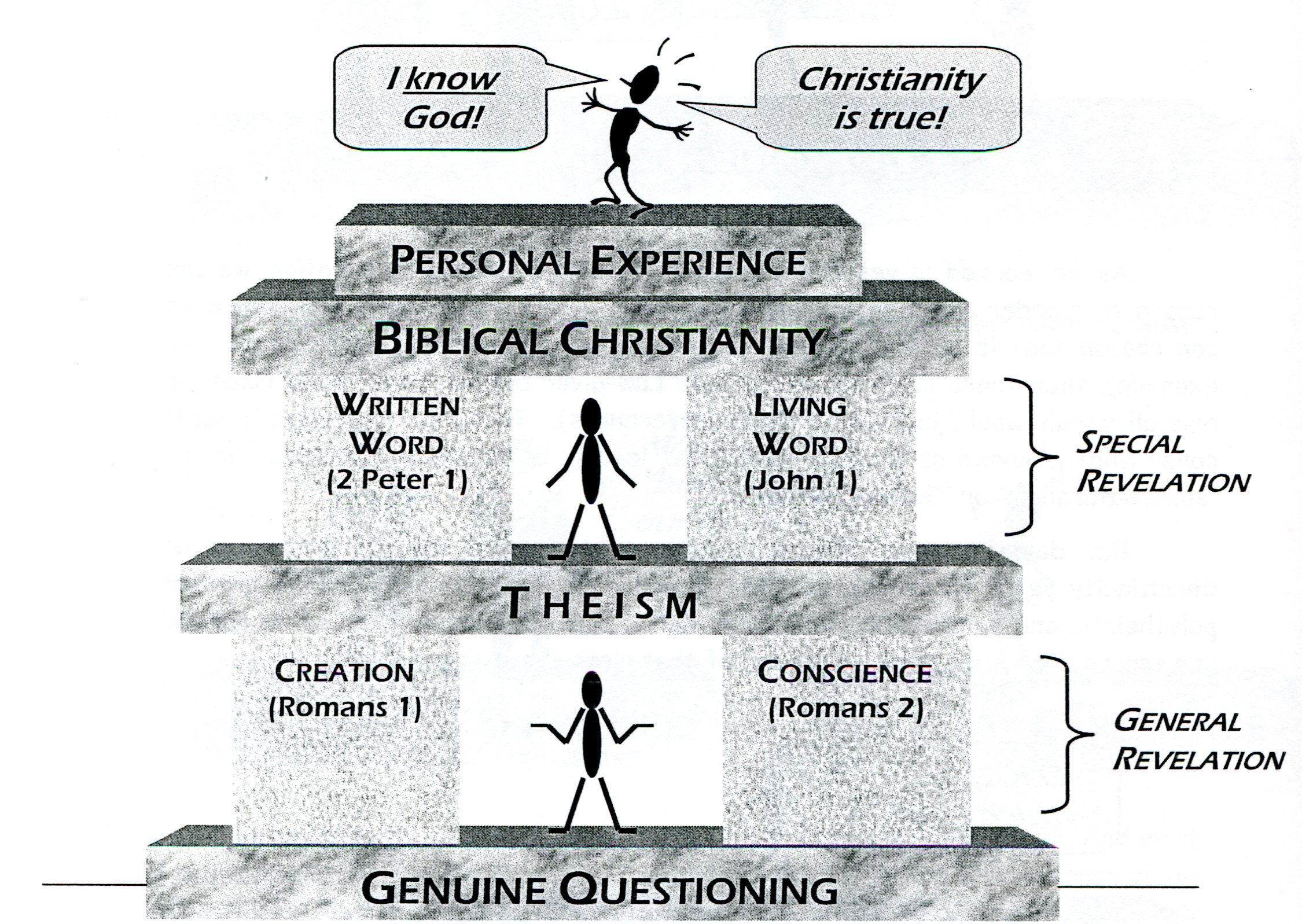
If you look at the illustration below, it shows you the progression that it takes to hold a Christian worldview.  You cannot hold a Christian worldview until you move from an atheist position.   Similarly, you cannot hold a Christian worldview, until  you know what type of theistic position you hold.  Do you believe in one God (monotheistic), more than one god (polytheistic), God is in everything (pantheistic), etc…  Likewise, you will have difficulty trying to convince someone that the Bible is the inspired word of God, if they don’t believe that a God or gods exist.  The same way someone will have difficulty with the claim that Jesus is God, if they don’t trust the Bible as a reliable source.

As you talk and ask questions to others about what they believe you will discover what they believe and where they are in the progression above.   Then you will know where to start with helping them along the way towards a Biblical worldview.  A friend of mine, Chris Sherrod, who teaches apologetics and has been published in several books uses an illustration of a set of pillars to show how the different evidence builds upon more evidence to provide a solid case for Christianity.

Building a Case for Christianity

Over the next weeks and months we will begin to break down the 4 pillars above and examine the evidence that God has given us.
As always, questions, comments, and discussions are welcome.


Conversational Apologetics

October 3, 2011

When you strike up conversations with people, especially for the first time it is important for you to find out where they are and what they believe.  For example, Do they believe in God?  Do they have another world view? (Islam, Buddhism, etc..)  Do they believe the Bible is true?  There are many questions you can ask them.  Each question will help you determine where you need to start in your discussions with them.

Avoid putting people in a box.  Just because some says they are Mormon or they are a Muslim doesn’t mean they will fit into the general beliefs of their religion or worldview.  You will find that people have varying beliefs or individual beliefs rather than fitting into every standard you know.   Just as someone else might assume you believe something like speaking in tongues, or predestination because you are a Christian.   Asking questions will help you determine what they believe and why?

Here are some questions that you can ask people to help you figure out what they believe and this will help you know where to start with them in your discussions.

1. Do you believe in a God?
2. Do you believe in one God (monotheism) or many gods (polytheism)?
3. On a scale 1-7 seven, 1 being total atheist and 7 being a total theist, where do you stand?
4. Are you a Deist or Theist?
5. How do you believe the world came to be?
6. Do you believe in evolution?
7. Do you think the Universe had a beginning?
8. Do you believe that humanity has Free Will or is Determined?
9. Do you believe in Absolute truth?
10. Do you believe that truth is relative?
11. Where does Evil come from?
12. Do you believe in Satan?
13. Define Evil.
14. Where do morals come from?
15. Do you believe in an Objective Moral?
16. What is Sin?
17. Do you believe that the Bible is inspired from God?
18. Do you believe the Bible contains errors?
19. Do you believe in miracles?
20. Do you believe in Jesus?
21. What do you believe about Jesus?
22. Do you believe that Jesus is God?
23. Do you believe Jesus rose from the dead?
24. What is Faith?

You can also ask them to define terms that they or you might use in your discussion.  For example: Mormons and Christians both us the word Trinity but define it by different meanings.  Christians view the Trinity as the 3 (Father, Son, Spirit) in 1 triune God who has three unique personalities but is 1 God.  Mormons view the 3 Gods (Father, Son, Spirit) referred in the Bible  who are not the 1 and same God.

Don’t forget 1 Peter 3:15:
“But in your hearts set apart Christ as Lord. Always be prepared to give an answer to everyone who asks you to give the reason for the hope that you have. But do this with gentleness and respect,”

As you have conversations with people don’t forget one of the most important things, to talk with them with “gentleness and respect”  You are not out there to coerce anyone into believing in your Christian worldview, you can be bold and persuasive, but don’t ever try to force someone into a relationship with Christ.  It has to be their choice.  You are also not out there to “slam” anyone or make them look stupid with your knowledge of apologetics.    In the next post I will explain a method for presenting the Gospel and simple strategy for helping other people understand your Christian worldview.


Defining Terms: ad populum

October 2, 2011

A few days ago I used a term in a post that I didn’t explain, you may or may not have known what it meant.   Referring to a debate that  I watched between 2 men I said the following.   “One person had a set of thoughts in which they presented in turn and the second man, took a position of doubt, and really questioned everything that was said by the other person and other ad populum topics.”

to the people

ad populum – ad populum is Latin for ‘to the people‘, the phrase ad populum is used to describe a technique in debate where you make an appeal ‘to the people’ or the popular vote.    You might consider it to what is known in general to the majority of the population or think of it as common knowledge.

The danger with ad populum is that even though it is commonly known, believed or accepted, it doesn’t mean that it is right or truthful.  Phrases like “everybody knows…”,  “most educated people…”, or “all religious people know…” are examples of ad populum.  Often times the facts and evidence are  left out, and perhaps done on purpose to avoid having to deal with the reality of the real evidence.

Examples:
Everyone knows that the Bible is full of contradictions.
All scientists believe that Evolution is not longer a theory but now accepted it as fact.

So how do you handle someone who chooses to use an ad populum technique with you in a discussion or debate.  Simply call it for what it is.  You may want to ask for the facts behind the claim.  For example in our examples above, you can simply ask the person “What contradictions?”  Ask them to give you something to defend against or an opportunity to explain a “so-called” contradiction.   Or to ask what the facts are behind the theory of evolution.

Lastly you can remind them that just because something is accepted by the popular consensus, doesn’t mean that it is correct.  For example: If a majority of the class got an answer wrong on a test, it doesn’t mean that it would become right.  If ad populum always meant it was the truth, then the issues of Nazi Germany would have meant that it was okay for the Nazis to do what they did to the Jews because a majority of Germany agreed with it.  Slavery was an accepted way of life for many countries in our recent past, but that doesn’t mean that it was right either.


Defining Terms: Theism

October 1, 2011

A few more definitions to add to your knowledge of data base in studying apologetics.  We will look at Theism and the rest of his Family that are connected together.  Hopefully the illustration will help you understand it as well.

Theism – The belief that there is a God and that He is knowable and involved in the world.  It comes from the root word ‘theo‘ meaning ‘God’.  For example, theology is the study of God.

theismMonotheism – The belief that there is only one God in the universe.  It comes from the prefix ‘mono’ meaning ‘one’.  Judaism, Islam, Christianity are examples of Monotheistic worldviews.

Polytheism – The belief that there are many gods in existence in the universe.  It comes from the prefix ‘poly’ meaning ‘many’. Hinduism and the Greeks God’s of Mythology are examples of polytheistic worldviews.

Pantheism –  The belief that God is the universe and all that comprises it: laws, motion, matter, energy, consciousness, life, etc.  It denies that God is a person and is self-aware.  The prefix ‘pan‘  means ‘all‘ or ‘of everything‘.   Buddhism is a pantheistic worldview.

Panentheism –  The belief that God is in the universe.  It differs with pantheism which states that God is the universe and all that it comprises.

Atheism – The lack of belief in a god, and/or the belief that there is no god.  The position held by a person or persons that ‘lack belief’ in god(s) and/or deny that god(s) exist.  The prefix ‘a‘ meaning ‘not’ or ‘against’  literally translates ‘not God‘ when put in front of the root word Theo.  For example amoral would mean the opposite of moral.  Naturalistic or a Darwinian evolution worldview would be atheistic.

Agnosticism – The belief that the existence of God is not knowable. The word is derived from the negative ‘a‘ combined with the Greek word ‘gnosis,’ which means knowledge.  Hence, agnosticism is the belief that God cannot be known.  Someone who might call themselves a Skeptic would most likely have an agnostic worldview.

It is important that we understand the role of the law of non-contradiction when discuss the different positions of theism.  For example, you cannot hold both a theistic view and an atheistic position at the same time.  Either God exists or he doesn’t.  Similarly you cannot hold both a monotheistic and a polytheistic position at the same time either.  There is either one God or multiple gods.

There are a few more other words we could discuss, but we will save them for later in another post.  What position do you take, and why?  As always questions, comments, and discussions are welcome.


God’s Existence: Why is the evidence not overtly clear?

September 30, 2011

In a previous post, I listed out a short summary of the evidence/reasons that I believe in the existence of God and have a Christian worldview.   Towards the end of the post I admitted that none of the reasons were absolute “slam dunk” case ending evidences.  I cannot point to God in a denotative way.  For example, I could point out Amy who is my wife, or Bob who fixed my car, or Luis who made me a Taco for lunch.

Many atheists who reject the idea of God, do so because God cannot be 100% proven by a scientific method or by some other method of proof, be it philosophical,  historical, or etc…   Let me be clear about what I am saying here, God DOES reveal himself to us through science, history, through our philosophical mind, and other ways.  What I’m not saying at is the degree at which God does this is not 100% as the same way we might test something with the scientific method or know that Abraham Lincoln was president of the United States.

According to the Bible, God has progressively revealed himself to us in a variety of different  ways over the span of time.  You might picture a slowly moving curtain that is unavailing the prize behind curtain #1.  I will save a deeper discussion on God’s revelation for a future post, but will let it rest for now.  One of the ways that I have found the Christian worldview reliable is because it not only works within 1 method of proof, but that it works well with all the different methods, not least of all, science.  If God does exist, many atheists ask, “Why doesn’t he make the evidence clear?”  Atheists offer answers for us such as, “maybe He doesn’t exist.” or “he is not all-powerful enough to do so.”  As a Christian you may have asked that question for yourself as well, I have.  The following paragraphs are some of my thoughts on that question.

As I mentioned before, the Bible says in Hebrews 11:6 “And without faith it is impossible to please God, because anyone who comes to him must believe that he exists and that he rewards those who earnestly seek him.”  Why Faith?  Why does God want us to have a trust in Him that is not totally grounded 100% by facts and evidence.  Some might say that is mean.  It is actually love, here’s what I mean.

Let’s follow the thought out for a little while.  If God exists and let’s say he did 100% show himself to us by some means.  Perhaps he used an airplane to write in the sky constantly, or for Star-trek fans, God beams himself down to earth and visits with us, performs miracles, that we can see with our own eyes, and record them on video tape and post to YouTube.  Better yet God shows us Heaven, but then says we can’t come in unless we believe in Him.  Sound silly?  If that did happen, anyone who didn’t believe in God would be well, stupid.  Like telling someone, you need to eat  in order to live.  For God to erase away any doubt, to not require faith in him, would do away with free will.  Without free will, we would be like mindless robots that just did what we were told to do.  We wouldn’t love God because we wanted to, we would love God because we had to.  You cannot force love, if you do, it’s called rape.  I will address the issue of free will and determinism later, but let’s get back to the point.  I believe the answer lies in the sovereign, perfectness of God.   It is exactly how God has planned it for us.  A perfect balance.

What is the balance?  I don’t think I want to put a number on it.  That answer might vary from person to person.  I know that the more I study both sides of the debate, the more I am convinced and for me the number is rising.  Where are you at in your opinion?  Is it 50%, 51%, 60% for you?  Perhaps lower or higher.

There is a great story in the Bible of Thomas (John 20:24-30) .  Thomas was given the nick name “Doubting” Thomas by someone.  The word doubt has a negative connotation, and I think we give Thomas an unjust shake at what He said.  Thomas missed the first appearance of Jesus to the disciples after His resurrection, and the others who saw Jesus went to tell Thomas about what they had seen.  Thomas made the statement “Unless I see the nail marks in his hands and put my finger where the nails were, and put my hand into his side, I will not believe it.”  Thomas’ doubts were soon wiped away when Jesus appeared to him.    All Thomas was seeking was some truth.   I have found the same to be true in my life, the more I look and examine the evidence, the stronger my faith becomes and the less my doubts and questions become.

Doubt for a while is good, it leads to truth-seeking, answers, but you cannot stay in doubt forever, soon you must move on.  I watched a debate not to long ago between 2 people over Morals and the existence of God.  One person had a set of thoughts in which they presented in turn and the second man, took a position of doubt, and really questioned everything that was said by the other person and other ad populum topics.  Even though there were points and positions argued, the man continued to doubt.  In the end, I really could not tell what the 2nd gentleman’s positions was, all I could take from his side was that he doubted.

Someone once asked the atheist, Bertrand Russell, one day if he died and stood before God and God asked him why didn’t he believe.  Russell responded that “He did not simply give me enough evidence.”   So how much is enough?  The obvious answer is, enough is enough.  I would just encourage everyone to keep searching and not give up.

As always  questions, comments, and discussions are welcome.  I will be posting a blog on Faith in next week or so, I believe it goes well as a follow-up to this posting.


Defining Terms: Worldview

September 29, 2011

If you are just starting to learn about apologetics it is good to be familiar with several of the basic terms that are used in discussions, debates, and by many of those in the creation and evolution realm.  I will start out very basic with some of these words and gradually get deeper and more complex with the terms.  If I use a word in a recent blog I will include it in the Defining Terms blogs that  I create.

Worldview – The dictionary describes it as a comprehensive conception or image of the universe and of humanity’s relation to it.  Everyone has a worldview whether or not they think a little or a lot about it.  I believe that a solid worldview must be able to satisfactorily answer basic questions about our past, present and future as well as give coherent meaning to all of the issues that we may face in our lifetime.   The human mind has a curious need to organize things and understand and make them coherent.

I have recently heard of a University of Florida student who was attending a lecture by apologist, Ravi Zacharias, and the student stood up and defiantly made the statement that “Life doesn’t have to be coherent” and demanded that Ravi Zacharias give an answer to why it should.  Dr. Zacharias responded that he would like to help the student, but before He answered that question, he had one question for the student.  Dr. Zacharias asked him, “Would you like my answer to your question to be coherent?”  The student stood quietly there for a moment and then just sat down.

What goes into making our worldview?  Everything.  Everything we experience from the time we are born until this very present moment that you are reading this blog accumulates to the sum of our world view.  Our Nurture, Our Nature,  Our Experience, Our Relationships with People (bosses, parents, peers, etc.), Our beliefs, Our Actions, the list could go on and on.  In my Christian worldview, God and the Bible,  have a big part of every single persons worldview on earth, whether they acknowledge God or not.  Someone who holds an atheist position would of course disagree.

A worldview does not have to be religious by nature.  By religious, I use the definition of a strict devotion to a supernatural being, higher power, God or gods.   Worldviews can be based solely on scientific laws and knowledge and whatever a person views as coherent and true.  For example someone who calls themselves a Darwinian evolutionist has a worldview that holds an atheistic or agnostic values.  Another worldview that I just learned about today are Raliens.  They believe that human life was seeded on this planet by extraterrestrials.

I am constantly self-examining my own worldview with the knowledge that I receive almost daily.  I want to make sure that I am as intellectually honest with myself about what I believe as I can be.  In other words, I like to keep an open mind.  Over the course of my journey in life I have found that my Christian worldview has for the most part stayed the same and I still feel that it is one that is the most coherent of all the worldviews I have examined.  The Christian worldview is durable, it can withstand the constant scrutiny from outside and internal sources.  Through out the months and weeks to come I will be examining the different aspects of my own worldview and also comparing them to other popular or mainstream worldviews.  I will do my best to offer the evidence, you can decide what you want to from the facts.

As always questions, comments, and discussions are welcome.  In the near future I will post a follow-up with this blog about the challenge by Richard Dawkins, that people basically take the worldview that they grew up with.  Indoctrination, as he calls it,  by those who raise their children into religion, he even goes to the lengths to call it child abuse.  Most likely for the reaction.


Why I believe

September 28, 2011

Why I BelieveStarting off from the gate I want to summarize why I believe, what I believe about the existence of God and my faith in the Christian God of the Bible, and His incarnate name given in the New Testament, Jesus.  This blog is meant to be a general one and I will spend the next months and years breaking it out piece by piece so that it can be swallowed and enjoyed bit by bit.

After studying many of the worldviews through books, articles, talking with people in person, I have concluded that my Christian world view is the most comprehensive, complete, and logical worldview of all the many different worldviews including atheism.  While it still holds some difficulties and challenges, it stands tall over all the other worldviews.  In no particular order, here is Why I Believe…

1. Faith.  Yes Faith, there is a dual definition of faith floating out in the sea of apologetics, in short a blind faith and a Biblical faith.  I will explain this in greater detail in a soon coming post, but in short I believe Christianity takes and uses both those types of faith. I am convinced that most people do not understand the true definition of Faith.  Hebrews 11:6 says “And without faith it is impossible to please God, because anyone who comes to him must believe that he exists and that he rewards those who earnestly seek him.”

2. Creation.  When I examine the world in which I live, I see evidence for a beginning of the universe, I see intelligence, and a mind behind the matter.  I have not found any answer in the material world that points to other trustworthy conclusions.

3. The Human Mind and Soul.  Why are we conscience? Why are we special?  Why do we have the ability to reason and think?  Why do we have  moral absolutes?  How do we judge what good and evil is?    In a world without God, these things are not possible.   The Bible describes the human condition perfectly.

4. The Bible.  The Bible makes the bold claim to be written  inspired word of God, but should we just except the Bible as God’s Word, because the Bible tells us so?  The Bible is a reliable book that is written in many different styles, by more than 40 authors, on 3 continents, over a period of about 1,500 years.  It is the most unique book ever written and for centuries it has stood the test of time and scrutiny by many.  When you compare the Bible to all other religious books, the Bible stands tall.

5. Historical Jesus.  Jesus was a real person, despite the constant attempts to blur the evidence.  But, Jesus made some bold claims about who He was and what His mission was about.  There are many sources, outside of the Bible that confirm the existence of Jesus and record some of the claims He made that are in the Bible.  Christians can even exclude even the evidence of the Bible and some of the other questionable secular documents and still make a case for Jesus existence, that is solid.

6. The Church. Yes, the church.  I realize that sometimes the church (people) can look pretty bad and can be rather disappointing, but the church (the people) has also made some great strides and impacts in the world in where we live.  Christians have been of the forefront leading the charge in several advancements for good in our world.  Slavery, Women’s rights, and even Science.

7. Religion.  Religion is mans attempt to come to God.  Religion shows how we have a yearning to get to God, just like we have a desire for food or procreation.  God gives us a desire that can be met by Him just like finding food and companionship.  Even though many people have wrongly been lead into believing in something that they haven’t researched, the desire for God is there.    I have always preferred the phrase, relationship over religion.

8.  The Empty Tomb.  Perhaps the greatest evidence for my belief.  The resurrection is key to Christianity.  Without it, as Paul says in 1 Corinthians 15:14 , my faith is in dead.  When you examine the evidence for the resurrection you are not left with any other choices that make any sense at all.  Jesus made claims that would rise from the dead, something that  charlatan would not dare to do.

9. Personal Experience.   I realize that my own personal experience is not as strong a proof as some of the other items listed above.  For example, I could say that God answered a prayer request of mine, a Mormon could say the same thing.  Some personal experiences are subjective.  But, this doesn’t mean I should throw out the personal experience all together.

Let me stop you before you start to pick apart these individual items by saying that no single one of these proves anything.  No, I cannot in a denotative way point to God and say “see, there He is” like I might point out Bob who fixed my car or Larry who made me a sandwich.  (I will address why I think that this is perfectly how God designed it to be in a later post.)  Let me point out that each of these individual areas lead or point to a particular conclusion that God does exist, and that Jesus is who He claimed to be.  It is the sum of the conclusions that add up far better than any other worldview.  Biblical Christianity uses all the different methods of science, philosophy, reason, and reality to build a strong case for a Christian worldview.  No other worldview can claim that which Christianity does, they either fail in arguments in one or more areas by contradicting themselves or by not being able to produce the evidence that Christianity does.

If you are searching for answers, and want to start looking at different worldview, that is great, can I offer a suggestion?  Start with Christianity.  There is something about Jesus that most of the other major worldviews want to include him in their teaching.  To Muslims, Jesus was one of 28 prophets, In Hinduism Jesus is a good moral teacher, Jehovah’s Witnesses and Mormons view Him as the Son of God, by which we can earn our salvation.  Jesus is the central feature in Christianity, not only because of his teachings but because of who He is, and claimed to be, God.

As always, questions, comments, and discussions welcome.  I am looking forward to the breakdown of these items that I have listed above.  In my next few posts I will give some basic information about apologetics and lay a foundation and order down for looking at the evidence piece by piece.

The Light Bulb Comes On!

September 28, 2011

Last night after typing up My Story and posted it to my blog,  I went to bed I had some trouble falling asleep.  I usually don’t have any trouble, maybe it was the mountain dew I drank around 11pm, not sure.  My mind was full of different things from the day.  Things I am reading about, church and family things.  Then it hit me, I had been considering getting back to writing more on my blog and was wanting to find a way to organize some of my thoughts in a coherent way that  I could keep up with.  I believe I had found the way to go.  I have  kept a notebook of my studies and notes on books that I have read over the last year.  I had organized it into a way that I could find what I was looking for quickly.  I would just simply use the same type of format that I have in my notebook.  Now I really couldn’t sleep my mind was racing with ideas and how I would start out.   I have loved teaching apologetics, but I know  I couldn’t get away with that each week at church, so, I decided that I will use my blog to post articles, thoughts on what I believe, and bits and pieces of arguments and definitions within the apologetic studies.  I have found my angle, to educated anyone on how I came to believe and trust in God, specifically in my Christian faith.

I realize that this will be lots of work, but I have a passion for it, and I will enjoy doing it.  I know that there are going to be those might read my blog that disagree with me and my worldview, that’s OK.  I would just hope that they as well as anyone would keep an open mind to the ideas that are presented, as I try to do with the books, articles, and blogs that I read.  I will welcome any comments for and against my views expressed.  The only thing I will ask is that the discussions are kept clean of hate speech and name calling.  I will post anything in response as long as it is truthful and free of meanness.    I will follow the rules for myself as well.   I was frustrated a few weeks back when I started dialoging with a gentle man from San Francisco about the truthfulness of the Bible, and after reading his article I found a few things that I questioned and posted a response to.  I gave him a few facts and things to consider in a reply, but he never approved my comments to be seen by the public readers.  I was disappointed that he didn’t post my comments  for whatever reason it was.  I suspect that it might have made his article look bad, I guess I will never know, because after several attempts to contact him now, he has just ignored my messages.    That is also something that I will try not to do to anyone who leaves comments on my blog.  If it becomes time-consuming, I may have to change the time frame in which I respond, but I don’t think that will be a problem, I’m not anyone famous, and I don’t care to be, and hundreds of people will not be reading my blog daily.

So here goes, let the blogging begin, and I hope that it will help you in your journey, to discovering what I have found to true and trustworthy in my relationship to Christ.  As always, I will welcome any comments, questions, and discussions about anything I type.  In my next blog I will summarize what are the factors, evidence, and reasons for my belief in God and my Christian faith.


My Story

September 28, 2011
Amy and me

Amy and me

A few weeks ago our pastor challenged the church congregation to “Be Courageous and Share Your Story”.  A few days later it hit me that one way, not the only way, I could do that would be online through my blog or on Facebook.  So here it is, Here is my story and I welcome any questions, comments, or snide remarks.

I grew up in a great home, a happy home, and while  I felt very sheltered from a lot of crazy things in life, I knew that  I was blessed because of the environment I was raised in.  My parents were both involved in church and so consequently, so was I, but again I didn’t mind.  I loved church, I love the people in the church.  My friends in church were different from most of the other students at school.  I had a few good friends at school, but most of my close friends were in the church with me.  Because I had a long history of being in church I knew a lot about the Bible, facts about God, and felt like I had a grasp on why things were the way they were.  As an early teen I began to notice that my brother and some other friends were making a choice to trust Jesus as their savior and they were baptized later on.  After a few months, it hit me that I knew a bunch of facts about the Bible and God, but I had not yet taken those facts to heart.  I had not really placed my faith, my trust in Jesus in my own personal way.    One night, while at a youth ministry event I really felt convicted within me to stop putting off what I already knew I needed to do and go talk to someone about making my faith personal.   I still get reminders today, because of my job,  of how scary that can be for a teen, to walk out of a pew or crowd and go talk to someone.  I knew what I had to do, grab the closest person near me and make them go with me!  I grabbed a great friend named Susanne and stepped out to find someone to talk to.

That night, April 30, 1988 I sat down with a man who went over the gospel of Jesus with me quickly to make sure I understood what I believed and what my need was.  For the first time I placed my trust in Jesus, that His death on the cross was payment for my sins and even though I didn’t understand it all, I knew that I was far from perfect and that I needed Jesus not only for an eternal life, but for a great life now.  I said a short prayer and asked God to forgive me of my past sins, I placed my belief in Jesus, for who He said he was, and I turned my life over to God to be my Lord, or boss for a lack of a better term.  A few months later I was baptized by my grandfather, who also was a pastor, in Yazoo City, Mississippi.

Since I have placed my faith in God I have had some interesting times, some great times, some challenging times, but they have all helped me grow in my relationship to God.  During my college years, I struggled with the idea that, perhaps I was a Christian only because I was raised in a Christian home.  I didn’t want the faith of my parents, I wanted to own my own faith.  I began to look at all the other worldviews and examine then for myself.  I knew after all, that not all the different worldviews could be correct.  I begin reading books on other religions and studying them to get a better understanding of them.  I admit at first I kept a close grip on my faith and didn’t want to be pulled from my own faith.  Some might say I was studying with a presupposition.   I was lucky enough to be taught though by my pastor and other teachers that I should do the research and examine things for myself and not just except the way things are because someone tells me so.  Trust is earned.  What I read was backed up by what I read for myself and what I found to be true in life.  My faith was becoming my own.

Right before finishing college, I began to question my career and what God really wanted me to do after I graduated.  I had always felt that God wanted me to be a teacher, but the last few months before graduation, I believe that God used a few different people to speak to me about being a pastor/minister.  After a few months of pushing the idea aside I finally quit telling God “no”, and I told God that if He wanted me to do something different with my life I would do it and trust Him for the things I didn’t know.  It was amazing what happened immediately after I had that conversation with God in my prayer time.  I felt this peace just fall over me like a heavy blanket.  I knew right then and there that I was not going to be an orchestra teacher anymore.

Right about this time, God opened a door for me to work in a church as an intern for the youth ministry.  Six months later the church came back and offered me the job permanently.   That was in 1997.  Fourteen years later I have had the joy of serving 3 churches as their student pastor  and have loved every minute of it.  I don’t feel like it is a job, but rather a calling.   Over the past 14 years I have grown in my passion for teaching the Bible and have also found a love for apologetics.  Apologetics is the study of “why you believe what you believe” or backing up your faith with reason and evidence.  Apologetics has allowed me to get a better grasp in what I believe and made my faith stronger.  Over the last few years I have opened up my reading and began to read books from both sides of the debate between atheists/agnostics and believers.  I try to read both sides to get an honest view-point from both sides of the aisle.  I have yet to find anything that worries me or that might cause my faith to stumble.  My passion today still lies with both the teens in this generation and teaching them apologetics that will prepare them for the vastly different world in which they live today.  It is a different world in which I lived in 20 years ago as a teen.

If you have any questions for me I would be glad to try to answer them for you.  I don’t know all the answers, not even close, but I would be glad to share what I have found to be solid ground to stand upon in my life.

God Bless,

John


“I love it When a Plan Comes Together”

July 3, 2010

OK,  just got back from the movies.   I went to see the A-Team movie a remake of the TV show I watched as a child growing up in the 80’s every Friday night at 9:00pm.  I have to say  it was a bit disappointed with the movie tonight.  I’m not sure that if there is a sequel that I will go and see it.    I remember for years watching the Dukes of Hazard, and the A-Team back to back almost every Friday night for years.  It was great family time with the whole family and then off to bed at 10:00 when Dallas came on.  Several things I will remember about those nights like;  it was the one night we got to stay up late and the jokes about dad liking  Daisy Duke.

 Hannibal had his saying at the end of the program after the bad guys were caught and the adventure was over.  “I love it when a plan comes together.”  Everything seem to just work out perfectly and the good guys went home and we waited impatiently until next week to see what would happen again.  Sounds a little of the reality scope of life doesn’t it?  It was no fairy tale ending because they were always on the run from the MP’s and Cornell Decker. 

 The thought occurred to me on the way home that God might have the same phrase that He uses on us when all through our lives different things may happen and they might seem out of control and crazy, but in the end they work out for a “mission accomplished.”  The world can be a messed up place, and because of the sinful choices of people it can be hard to grasp the idea that God is in control and God has plan that He is working out, but it is true.  God is in control , He has a plan, and even when the world is crashing down around us or with us, God is there.

There are so many scriptures that show us that He is in control and that He has a plan for those who are His children.  Jeremiah 29:11, Ephesians 2:10, Romans 8:28 just to list a few.  It is always easier to look back after you have come through an experience and see where God used it to better you or to teach you something, or even to begin a new chapter ministry or life.  The hardest part is trying to see God in situations that you are currently going through, we often look for God working in areas when He may be doing something totally different with a situation. 

Are you going through a tough situation right now?  Do you struggle to find God working in your life some times?  Let me encourage you to do 2 things.  Remain close to God and His people (the church) they will be a great support for you.  Secondly, just keeping doing what God has called you do, being obedient to him with what you know He wants you to do, until the time comes and you know He wants you to do something else.  It may be weeks, months, or even years that will pass before you see how God was with you in a situation or how you grew in the tests and trials you passed through.  Rick Warren, Pastor and Author says in his book “Purpose Driven Life” that God often uses your greatest weakness or failure to be your greatest ministry in life.  Think of the possibilities of how God can use your experiences to help others  who are going through where you have already been.

  Maybe, like Hannibal Smith  you might even say “I love it when a plan comes together!”