“What Does This Mean?

February 4, 2024

February 4, 2024

Read Exodus 11-13, Psalm 35

What traditions do you enjoy? Are there special things you do during the holiday season or throughout the year that you look forward to participating in? What are some traditions you might take part in and not know exactly why you do them? I heard a story about a family tradition where the children passed down a recipe for a dish that instructed them to cut the end of the roast off. This was repeated over several generations until someone asked why they cut the end of the roast off. It was discovered that the originator of the family recipe did this because they didn’t have a big enough pan to roast the meat!

In Genesis 11-13 we have the instructions from God about the final plague that God would send on Egypt. Unlike all the others, this one would involve much preparation from Israel in order for them to avoid its consequences. The plague of the first born was going to be so impacting that it would cause Pharaoh to release Israel from 430 years of slavery. The Passover would be a special time that Israel would observe each year.

The instructions for observing the Passover were very detailed and for good reason. The Jews were to pass on this remembrance to their children going forward. It would have even greater significance when Jesus would come as “The lamb of God that takes away the sin of the world” (John 1:29). They are to use a year-old male lamb without defect. They are to roast it at Twilight. Consume all of it. – “head, legs, and inner parts” v. 9 Why no leftovers? – The Messiah was one body broken for all. Passover would be replaced by the last supper (See Matthew 26:26-29). The blood was to be put on the sides and tops of the door frames of the homes. They are to eat it with bitter herbs and Bread without yeast, which would symbolize the haste in which they were to exit Egypt. The manner in how they eat the Passover meal is symbolic. v. 11 “cloak tucked into your belt,” “sandals on your feet,” and “staff in your hand.” These are again signs of a quick exit for Israel.

What else do you see in these chapters? What words, phrases, or themes stick out to you? Write your thoughts below.


“Frogs, Boils, and Darkness Oh My!”

February 3, 2024

February 3, 2024

Read Exodus 8-10, Psalm 34

Has the Lord ever gotten your attention with something that you have seen or experienced? Maybe it was a close call with a vehicle, a poignant conversation that hit you right between the eyes, or maybe you were caught in a sin but given some grace to repent and change. In Exodus 8-10 we find God trying to accomplish something similar with Pharaoh with the plagues. God told Moses to go before Pharaoh and give him a chance to let the Israelites go or he would bring about plagues that Egypt would face. God knew what it would ultimately take, Pharaoh losing his own first born. He told Moses this ahead of time. (Exodus 4:23) Back and forth Moses and Pharaoh would go, each time Pharaoh would change his mind and not allow the Israelites to leave. Several of the plagues seem to be a direct attack on an Egyptian god, but not all ten plagues specifically describe an Egyptian god as they were known. God seemed to be sending Pharaoh a message I am greater than the gods in Egypt that you worship. Do you that God would do something today to get your attention like he did Pharaoh? Could it be when we are out of our relationship or walk with God that He would try to get our attention and bring us back under his will? Take your time as you read through the chapters. Some of the plagues the Egyptian magicians could replicate, some they could not. Some of the plagues affected all of Egypt and some only affected the Egyptians and God protected the Israelites from harm. One interesting fact that stands out to me is when Moses asks Pharaoh when he would like the frogs to go away. Pharaoh’s response is “tomorrow” v. 8:10. Why not right now or yesterday? Had Pharaoh become accustom to them or was he just willing to put up with them? It makes me wonder. What else do you see in these chapters? What words, phrases, or themes stand out to you?
Add your thoughts below.


“You’re Not the Boss of Me!”

February 2, 2024

February 2, 2024

Read Exodus 5-7, Psalm 33

Have you ever heard a child make this exclamation before? “You’re not the boss of me!” They may have referred it to another adult, a teacher, or a person of authority over them. In Exodus 5-7 we have a similar attitude coming from Pharaoh. God tells Moses to speak to Pharaoh. You know… “Let my people go….” Naturally, Pharaoh responds “Who is the LORD, that I should obey him and let Israel go? I do not know the LORD and I will not let Israel go” v. 2. Pharaoh may not have heard of the God of Abraham, Isaac, and Jacob, so he consequentially had no desire to listen or obey him either. We can find the same mentality today among people. They neither know or fear the Lord and their behaviors and speech reflect this attitude. Honestly, who would blame them? When my kids were growing up, sometimes they would come home from school and talk about something that someone did to them or their friend. I would try to remind them that most likely they were not Christians or faithfully living out God’s design for their life. The phrase, “non-Christians will do what they do or just comes natural to themselves” was often repeated. We might not live in a polytheistic culture today in America but that doesn’t mean that people don’t have their gods. The gods just change from Ra, Chemosh, and Molech to the gods of self, materialism, and other things we worship and deem important. The ultimate issue of a god is who has the authority over my life and determines how I live my life. Some might have one god they worship; others might have a pantheon of gods they have amassed for themselves. Christians often use the phrase “Savior and Lord” when referring to Jesus. We have Jesus as our Savior, but is he also our Lord? Does Jesus have authority, lordship, or is he our “boss?” Not just in one or two areas of our lives, Jesus commands us to love God with our “whole heart” (Mark 12:30-31). What areas of your life do you struggle to relinquish control to the Lord?

Psalm 33 is a beautiful psalm that has many familiar phrases in it. It praises the Lord for his creation, his righteousness and just actions. Verse 12 says, “Blessed is the nation whose God is the LORD, the people he chose for his inheritance.” The psalmist recognizes the “blessing” that comes from allowing God to lead and be our boss. When many people see the word “blessing” they might be tempted to jump to an idea of finances or material goods. That might be one way to look at it, but “blessing” is really about an attitude of happiness or joy. Some translations of the Bible capture this by says “Happy is…” rather than blessed. When we recognize God as the ultimate authority in our lives, he will bring us blessings.

What other words, themes, or phrases stand out to you as you read these chapters? Add your thoughts below.


“Excuses”

February 1, 2024

February 1, 2024

Read Exodus 2-4, Psalm 32

Are you the type of person who gives excuses to others? Maybe people give you excuses about why they can’t do something or why something was not completed. What are you most likely to throw out an excuse? Is it because of a weakness, or character trait that you need improvement in? In these chapters we read a lot about Moses, the strong humble leader. He didn’t start out very strong in the beginning.

Moses grows up as a Hebrew raised in the palace by Pharoah’s daughter. He really didn’t fit in with the Israelites or the Egyptians. 40 years later he flees into the desert from Pharaoh who tried to kill him for protecting a fellow Israelite. He’s been gone another forty years and then God comes calling. These verses are all about “who.” First “who” God is, and second “who” Moses is. Moses started out looking at himself.  He lacked confidence in himself even through God was calling him to a task. “Who am I, that I should go to Pharaoh and bring the Israelites out of Egypt?” v. 11. God’s Response – “I will be with you” v. 12. Moses wanted to dig deeper and asks, “Suppose I go to the Israelites and say to them, ‘The God of your fathers has sent me to you,’ and they ask me, ‘What is his name?’ Then what shall I tell them?’ 14 God said to Moses, ‘I AM WHO I AM. This is what you are to say to the Israelites: ‘I AM has sent me to you’” vv.13-14. Our confidence should be weak if it is in ourselves, but if it is in the Lord, we should have all the confidence we need.

Even with the “who” questions answered, Moses is still not satisfied and turns to the “what” and “how” questions. Exodus 4 Moses starts offering excuses. First Excuse: “What if they do not believe me or listen to me?” v. 1. God’s answer is that He will provide Moses with signs and miracles to perform to help Moses. Second Excuse: “I am slow of speech and tongue” v. 10. God’s response “who gave man his mouth?” v. 11 – God will provide a solution here also. “I will help you speak and will teach you what to say” v. 12. Moses realizes he is not getting out of this. He finally exclaims, “O Lord, please send someone else to do it” v. 13. God reaction – “the Lord’s anger burned against Moses” v. 14”. This is a dangerous place to be, to tell God “No.” This is the one thing we cannot afford to do, it is disobedience.

What has God called you to do, and you are still throwing up excuses or just outright telling God “no?” Take confidence in the God who called you to a task. Trust in Him and lean not on your own understanding.

What else do you see in these four chapters? What words, phrases, or themes stand out to you? Add your thoughts below.


Mindful

January 9, 2024

January 8, 2024

Read Genesis 8, Psalm 8, John 8

What are some things that you will never forget? Depending on how old you are, you might recall some of the details surrounding; the moon landing, when JFK died, when Elvis died, where you were when the challenger space shuttle exploded, the 9/11 attack, when Michael Jackson passed away, when a family member got married and on and on. These were big events in your life that made an impact on your mind.  On a side note, many skeptics will balk at the idea of the gospels being written down years or decades after Jesus had died and risen from the dead, but we must remember that Jesus’ resurrection was a huge event like many of the ones listed above. You might not remember what you had for breakfast 20 years ago, but you will remember the significant events that impacted your life.

Genesis 8 starts out, “But God remembered Noah” (and all the animals too). We are not talking about a God with amnesia here. This phrase is an anthropomorphic (places a human-like character trait on an object or something not human) phrase that shows that God cares and has compassion for Noah and the animals. God is the creator of the universe and everything in it. He could have hit the reset button, but he didn’t. He chooses to save that which He has compassion for. Over a year passes and the ark finally comes to rest on the mountains. The Lord dries up the waters and tells Noah he can leave the ark safely. The first thing Noah does is to offer and sacrifice to God for His protection. When we come to appreciate and love God for what He has done for us, we should desire to thank Him or give Him praise.

In Psalm 8 we have a similar theme. David gives praise to God, “O LORD, our Lord, how majestic is your name in all the earth!” v. 1, David is in awe of who God is and for His interest in His creation. He acknowledges that God is the creator of the “moon and stars” v. 3. Yet in verses 4-5 he sees the personal nature of God, “what is man that you are mindful of him, the son of man that you care for him? 5 You made him a little lower than the heavenly beings and crowned him with glory and honor.”

In John 8 we read the story of the woman caught in adultery. Most bibles have a note in them telling you that the earliest manuscripts do not contain John 7:53-8:11. My opinion is that it was not in the original manuscripts but was likely a scribal addition later when documents were being copied. I personal believe this interaction between Jesus and the women took place and was later added in from other sources or the oral tradition. Nothing in the 12 verses seems out of place or “unlike Jesus” from the other Scriptures. Jesus craftily keep the Law of Moses and single handedly dismissed the woman’s accusers. Jesus was mindful of this sinful woman and showed her compassion in her time of need.

The majority of John 8 is a dialog between Jesus and the Pharisees. It is started by Jesus’ statement, “I am the light of the world.” There are seven “I am” statements in the gospel of John. Jesus and the Pharisees hold a discussion over the authority to do and say the things that Jesus does. Then the conversation turns over to fathers. Jesus claims that God is His Father, the Pharisees want to name Abraham as their father, but Jesus disagrees. “’If you were Abraham’s children, said Jesus, ‘then you would do the things Abraham did. 40 As it is, you are determined to kill me, a man who has told you the truth that I heard from God. Abraham did not do such things’” vv.39-40. The Pharisees object that they are not illegitimate children and Jesus agrees with them here, but plot twist, Jesus tells them “You belong to your father, the devil, and you want to carry out your father’s desire” v. 44.

 In the final section of John 8, the pharisees get mad and start name-calling Jesus. That’s usually what happens in an argument when one side is losing or they don’t have their facts straight, they resort to ad-hominem attacks (a.k.a. name calling). Christians are not exempt from this either. We need to study and know what and why we believe least we get embarrassed and start it too. In John 8:58 Jesus makes one of the most pivotable statements in all the Gospels. The confused pharisees think Jesus claims to be alive during the time of Abraham, He was just not like they think. They question Him on this and Jesus replies with a quote from Exodus 3. When Moses asks God in the burning bush what His name is, God responds with “I AM WHO I AM” v. 14.  Jesus tells the pharisees, “before Abraham was born, I am!” v. 58. You might say, well that’s not really saying He is God, but to the pharisees of the day they knew exactly what Jesus meant.  We can tell by their reaction, they picked up stones to stone him. If someone were to commit the sin of blasphemy the punishment was death by stoning. We will see even more clearing from another interaction with Jesus and the pharisees in John 10 that this is what was going on.

What else do you see in these chapters? What words, phrases, or themes stick out to you? Do you understand just have mindful that God is toward you just like he was with Noah, David, and the woman caught in adultery? Add your thoughts and comments below.  


A Boy, A Prostitute, and A Murderer

February 25, 2010

OK, quick let’s play a round of try of Tri-Bond.  It’s the game where you list 3 things and then name what they have in common.  So here goes, what do a boy, a prostitute, and a murderer all have in common?    The answer, they were all used by God to do godly things for the Lord.

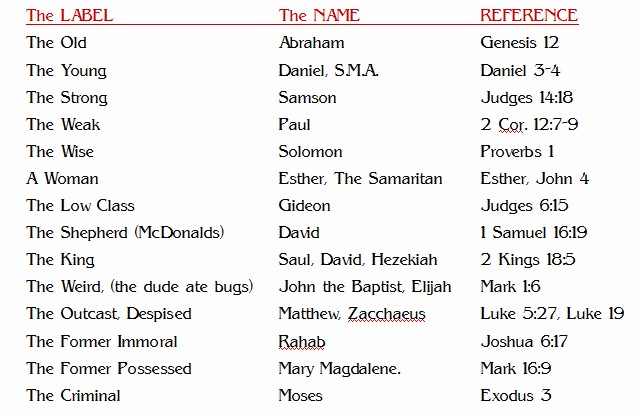
This post is for me, more than anybody.. Sometimes I have the habit of being very judgmental.  Sometimes it’s on myself and sometimes it’s aimed at others.   If you take some time and thumb through your Bible you will see quite a wide list of people who God choose to use to accomplish His will.   Below is a short summary of a few of the different kind of people who choose to use and the scriptures where you can read about them.

Each of these people had 2 things in common.  1.) They had to learn to let go of their past in order to move forward into what God had asked them to accomplish.  2.) They had to obey God and do what he asked them to do with what resources they had.  Yes, some of them questioned God and wanted to run away from it at first, but they all eventually let go of their past and obeyed God’s desire for their life. 

This is really a 2-sided coin, or rather 2 ways you can look at it.  Sometimes you might not feel like you are not the right person for the job or that you are incapable of doing what you know God has put on your heart, stop listening to the lies of Satan and take a lesson from the many pages of the Bible where God used ordinary, plain, average people to accomplish his will.  I love the scripture “When they saw the courage of Peter and John and realized that they were unschooled, ordinary men, they were astonished and they took note that these men had been with Jesus.” Acts 4:13.  Give me hope for myself.

On the flip side of the coin, you have to be careful that you don’t make judgments based on the outward appearance or past of people.  God can change people in an instant and with God’s help He can motivate ANYBODY into new areas leadership or accomplishments.  The old saying “Don’t judge a book by its cover” comes to mind.

Take the story of Jesus feeding the 5,000 in John 6:1-15.  Keep in mind the 5,000 was only the men counted.  There were other women and children there as well.  Jesus saw were the crowd was tired and hungry and he wanted to meet their needs.  He asks the disciples; “Where will we get food for these people to eat?”   I love the response of Phillip, “8 months wages would not buy enough for all these to have a bite!”  Then comes Andrew, Andrew was always a man bringing people to Jesus.  He brought his brother Peter to Jesus, and now he was bringing this little boy to Jesus who had 2 loaves of bread and 5 fish.  Andrew didn’t know what would happen and how it would happen but he knew that Jesus had the answers.  Be an Andrew in your life.  Always look for people who God can use no matter what they look like or what they have in the way of resources, education , social class, race, etc…

Also be like this little boy who didn’t have much, but he was willing to give it to Jesus to help or be part of the solution.  That’s what God wants from us, only what we have, and not any more.  Are you willing to give up all you have to let God do something great with it?  Will you be like Moses (a murderer)  or Rahab (a prostitute) and let go of your past and do what God has called you to do and let him use you to accomplish something great?


Leadership Principle #7 Say Your Prayers…

February 18, 2010

Leaders take their followers to prayer before God.  Prayer Changes things, even the mind-set of God.

Well after Moses was up on the mountain God tells him what the people are doing and tells him to go down the mountain to deal with them.  God told Moses that he would wipeout all the people and make a great nation out of the descendants of Moses.  Moses does what every good leader would do next.  Moses prayed to God to save his people.  He took them before the Lord in a way as to stand in the gap for them and to intercede for them when they were not able or ready to go to the Lord.

Leaders pray for their followers, there Bible study groups, their parents and families and intercede for them to the Lord.  The reason Moses prayed for them was that he cared for them.  They were under his care and his control.  This came first nature to Moses because of the things we have seen from him and his past.  Moses had just spent the last 40 years in the desert tending sheep, he was a shepherd to the people too.  Just as we know a shepherd keeps his sheep out of danger from wild animals and other hazards, so does a shepherd of the flock on God look after his people who God has given care over.

 As leaders, teachers, and ministers of the gospel of Jesus we know that there are many dangers in the world that can take hold of God’s sheep and entrap them into places where there is little hope of escape.  It is our job to look after them in ways to keep them safe from harm.

 One of the biggest ways to do that is to pray for them.  The older I get the more I learn to be a silent prayer warrior for those under my shepherd staff of leadership.  As I have grown in my knowledge of prayer and become more consistent in the practice of it, the more I am confident that it should be a first response rather than a last resort.

 The book of James shows us some basic principles of a godly and effective prayer life.  I would encourage you to read it and notice the following principles.

  • Pray with expectation that God will answer your prayers in His way.
  • Is there any sin in your life that would keep your prayers from being heard?
  • How earnestly do you pray?  How often do you pray to God?
  • Don’t just pray by yourself, involve the many to join you in prayer.
  • Pray for those when God puts them on your heart.  Don’t wait.

 There are so many great examples of others that went before the Lord and prayed for the people of God to wake up, to move, to stop sinning, to work together, to stand firm, and more for the Lord.

 Moses prayed for God’s mercy to be on the people and for him to “relent” his decision to destroy them all.  (v.11-13)  In verse 14 it tells us that God did relent in his decision to destroy them all.  This can not be over looked here.  Do you understand that the prayer of one man brought earnestly before the Lord caused God to relent of his decision for the people.  Know that when you go before the Lord that God listens to your plea for the people you are praying for and he will respond to you as well.

 I am learning currently in a situation that I am going through right now that those prayers will often take a great deal of patience and waiting on the Lord and His timing.  Often I want to jump ahead and try to do things in my own power and way, but I know God has called me into a season of prayer for the students I am over and I am asking God to move in their life and for them to get serious about their faith.   I must trust God’s plan for each of them and His timing is perfect.


Leadership Principal #6 Be careful of Appeasement

February 16, 2010

  The next leadership principle I saw was in Exodus 32 was with Aaron and Moses.  Here’s the quick summary.

 Moses had just left to go up to the mountain to meet with God and left Aaron, his brother in charge of all the Israelites.  Remember Moses had taken his father in law, Jethro’s advice and put leaders under him to serve as judges for the people.   What happens next, well somewhere between the phrase “When the cats away the mice will play” and the mental reminder of what my brother and I did when my parents left us at home alone sometimes could be a good description.  The people got bored with their lives and decided to try to have a little fun, and come on, how much fun can you have in a desert anyway, apparently plenty.  The people went to Aaron and asked him to build them gods that will go before them.  Flash back to Exodus 20 when God said not to be doing this….  What happens next is perhaps even worse than what the Israelites asked.  Aaron agreed and took the lead in building an image of gold that they could worship and call their god.   (v.2) There was not even a record of Aaron trying to stop the people or remind them that what God had told them in the past or was wrong to do.  In fact he took charge and lead the way.

 This same idea is what I see a lot of young leaders, parents, or ministers falling into, the trap of appeasement.  The young leader wants so badly to have some acknowledgement of leadership or to gain a better following from the people that they will compromise their personal convictions and even Biblical principles to gain acceptance from their followers.

 When Moses came down the mountain I love the conversation that Moses has with Aaron in verses 21-25 of chapter 32.  It reminds me of those typical teen movies where the kids throw the party and mom and dad comes home early to find the party still going on in full power.  Aaron has some explaining to do.

 I know that this was a hard pill for me to swallow as a young minister.  I wanted the youth to like me so bad, I thought that agreeing with the youth on smaller issues would lead them to respect me more and follow my lead.  What it actually did was to create an inconsistent leader in myself and cause them to think they could get everything they wanted from me, which made the problem worse over time.  Over time I have learned to say “no” more and more and learned to stick with my convictions and listen to the Holy Spirit rather than the immature youth when it comes to decisions made in my youth ministry.

 There are two different ways to look at this principle of leadership.  First, if you are a minister who tends to make decisions based on the temperature of the people around you, you should consider making most of your decisions based on principles.  Those principles based on the word of God will best of course.  Don’t be afraid to speak up and talk to other leaders in your field and draw great advice from them about their past experiences and mistakes.  That is after all the entire premise of these principles that I am writing out.  There are no points lost or weak leadership detector that goes off when you ask someone else for advice.

Secondly if you are an older more mature leader be careful who you leave in charge over the group while you are away.  Know your helpers, assistants, and team members.  Help them by making decisions for them and giving them an outlined guide with expectations.  The more specific you can be the better.  Perhaps Moses should have said to Aaron before he left.  “Remember the house rules and no making idols while I’m gone.”

 I know as a parent I have to leave specific instructions for the babysitters to follow while my wife and I are out on our date.  The things that I know and expect to come natural may not be so natural for the babysitter.  After all these are my children, my most prized possession.  I want them well taken care of.

 Years ago I had gone on vacation for a week with my family and had given the responsibility of teaching the med-week lesson to a relatively new couple in the church and in youth ministry.  I had gotten to know them well and knew they were real conservative and I thought the lesson would be no problem for the husband who had served in a church before.  When I came back form vacation I felt a little bit like Moses did, no there were no golden calf’s erected in the youth room, but I did come back to 2-3  students who were literally crying and upset because they were told, and I quote “that if they watched or read any of the Harry Potter books or movies that they were not Christians and not going to Heaven.”  This was during the time when Harry Potter first came out and I didn’t realize that my 2 newest youth workers/parents had the strong opinions that they did towards Harry Potter.

 I spent a few sessions counseling the youth and showing them the scriptures in the Bible that talk about salvation and I had to meet with the adults and explain it to them as well.   I should have known them in a more personal manner before I allowed them to teach for me. The couple had let their personal convictions or dislikes for Harry Potter even take a higher place than the word of God.  This is why everything we do must be based on principles based in the word of God and not on our feelings or personal opinions.  Those have to come second.

 To give you a more recent example, after coming to Westside Baptist over 5 years from now I was blessed to have a pastor who was very good at leadership development.  Over the course of the first few years he soon discovered one of my weaknesses in the area on finances.  I have always been weak in that area and have struggled with budgets.  The pastor began to help me in this area by giving me 2 things; accountability and specific guidelines to work with in youth ministry.  At first I didn’t like the idea having to spend more time on the things I hated and was not good at, but over time I learned though the questions asked and by following the guidelines he set for me to be a better steward of my budget and to give it the time needed to answer the details of the “small things.”  I still have a lot to work on and will always, but I am so thankful that he gave me those guidelines and held me accountable to himself.


Every Leader Needs a… Jethro?

February 3, 2010

Jethro Bodine

That’s right, Every leader needs a Jethro, and no, I’m not talking about the one from the Beverly Hillbillies, but a much older one and one who was very wise.  This Jethro was the father-in-law to Moses. 
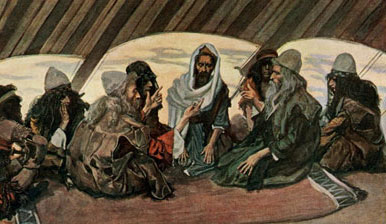
Jethro giving Moses advice

After the Israelites made their way into the dessert and begin to get used to the new life of Manna, Quail, and water from a rock things began to settle down.  Jethro had heard of all the great events that had taken place for Moses and the Israelites and wanted to reunite his family together again.  After meeting up in the dessert with his wife Zipporah, his father-in-law Jethro, and their two sons Moses began to share in person all the mighty works that God had done for them.  (Ex. 18:1-11)

After Moses spend some time with the family, it was then time for him to get back to work.  What did Moses do for work?  According to the scripture (Ex 18:13-16) he sat around all day acting as sole judge for the people handling disputes and arguments over everything from A to Z.

When Jethro saw what was going on he recognized that it was not a good thing that Moses was doing.  I think he saw the beginnings of a workaholic in the makings and perhaps new what it might do to Moses and his family.  Jethro offers some great advice to Moses and we will take a look at it and break down the advice, but, first it is important to see that Moses took the advice from Jethro and didn’t ignore it.  (Ex 18:24)  I think that this was a big step in the “young” leadership level of Moses.

The following are 3 reasons why we might not be as smart as Moses and ignore advice from others.  First, because far too many times we as leaders think we have it all figured out and we often turn a deaf ear to other advice from Godly men and women.  After all, God put us in charge right?  It also could be that we are insecure about our position and don’t want to take advice from others in fear that we will not look as smart.  Yet, another reason might be that we are in the position and enjoying the power a little too much and we don’t yield ourselves to other advice because we see it as a sign of giving up power.  

If you have found yourself dealing with any of those thoughts you need to pray them out of your system and recognize that Satan doesn’t want you to be smart like Moses and learn from others around you that are older and have more experience.  Young leaders have a greater tendency to fall into these pitfalls because they have had fewer years of experience and that budding desire to be young man or woman of God sometimes leads us make hasty decisions that we think are correct, but are not.  There is much excitement and emotion in youthfulness.

So let’s take a look at the advice that Jethro gave Moses.  There is much we can learn from his advice also.

The wisdom of age allowed Jethro to point out to Moses the end result. (Ex 18:17-18)  There is a lot to be said about knowing the end result.  Often times we start a process or idea without often thinking all the way through to the end.  This can lead to unnecessary steps in a plan or even repeated steps in a plan which wastes time, energy, and resources.

Second, Jethro encouraged Moses to use other people and not try to do it all by himself.  This process is called delegation.  Not too many leaders want to dive into that because they would rather “do it their way” or “in their time.”  Again I think there is a fear of giving up power or control when you delegate things.  When you have delegation in ministry you have to share the successes and the defeats, the good and the bad.  A selfish person finds it hard to share success with others, but there is no room for selfishness in ministry.

Jethro reminded Moses what his main job was, to be the representative from God to the people and to teach the laws of God and show the people how to live.  (Ex 18:19-20)  The judging had become a bigger issue for Moses and distracted him from his main purpose as leader of the Israelites.

Jethro’s advice was to select “capable men” (Ex 18:21) and not just anybody to share in the responsibility and position.  Here is the last leadership principle found in this chapter, Good leaders surround themselves with other good leaders or team members.

 Notice the “capable men” were described as godly men of integrity not as good-looking, well-liked, popular, those that have $20 haircuts or have beautiful families.  Jethro used the following descriptions:

            Men who fear God

            Trustworthy

            Men who hate dishonest gain

These 3 descriptions are very similar to the qualifications for deacons and overseers found in Timothy.  A good Baptist joke I know is that there are some churches that will take the list in Timothy and only focus on the divorce issue.  It doesn’t matter what kind of person they are as long as they haven’t been divorced.  That one qualification seems to rise to the top over the other ones.  A friend of mine has joked before that you can be a non-tither, wife and child beater and serve as a deacon as long as you haven’t been divorced in some churches.  Not all churches are like that and carefully look at all the qualifications equally. 

 A sure way to cause problems for yourself in leadership is just to settle for anyone to serve and help you in ministry and just throw anyone into a position without first.  I realize that you may say, there are not a lot of candidates to choose from out there, which is true but you can’t lower the Biblical standards just to fill a position.  There must be another way to go about staffing your needs.

 The result of shared ministry and delegation is that you can accomplish more together as a team than you can alone.  The old Oxen story goes that if 1 ox can pull 500 pounds each, but 2 oxen yoked together can pull 1,200 pounds.  Together more is accomplished.  Look at the Exodus 18:23, the scripture says it will both benefit Moses and the people at the same time.


Who do I File a Complaint With?

February 1, 2010

One of the great blessings you can receive from being a leader is to have a great group of followers.  It’s always encouraging to have people who are under your leadership that will support you in your endeavors and not question your actions and motives.  It helps build unity and can have a synergistic effect on the group, or body of Christ.  Just like becoming a great leader takes time, so does become a great follower.  And then again some people just never get it for what ever the reason.  Realizing that it takes time to develop will hopefully give you a little more patience and understanding in your area of leadership.

BUT, what do you do when you have those in the group that want to complain about something?  The complaint may be against you or something else that you have no control over, but as the leader you are the one that they will come to complain to, aren’t you the lucky one. 

When you move on in life you will always find complainers in everything you do.  The Israelites first complained to Moses saying we should have never left Egypt, at least we had food in the pot there.  (Ex 16:2-3)  They had taken a step of faith to follow Moses into the dessert and again just like the grumbling at the Red Sea, they began to grumble and complain at the first sign of trouble of no food.  Verse 2 says that the entire community was a part of the grumbling.  This just goes to show you that the Israelites must have been Baptist, you can’t mess with a Baptist’s food without expecting repercussions.  In reality it shows you that complaining can get to everyone and it can spread pretty easily.  In church and ministry situations you can find complaints coming from the most unlikely sources as well as the expected ones.   I imagine that the complaints started in one area or two of the entire camp and quickly worked their way around to the entire camp.  Times haven’t changed much and I know still that people like to talk.

Again, Moses wasted no time dealing with the complaints but immediately went to the Lord, he knew that God was the only source for his answers.  I remember as a young minister that I think I had to rely on God in a great deal of areas because there was a lot of new territory I was crossing into, granted I made my share of mistakes and still do, but as leaders earn more experience I think there is a tendency to rely more on yourself than on God as you did perhaps before.  We must always remember to rely on God for everything, big and small.

God responded to their need by giving them the quail in the evening and the Manna (heavenly bread) in the morning.  He gave them specific instructions on what to do to collect it and how much to collect each day. (Exodus 16:4-5, 14-19)   There is another lesson here that you can also pull from and remind people that God is a God of details and we need to be a people of details, obedience is important to God to the very smallest detail.  When you give instructions to those that are following you, they will not always be followed just like you asked them to be. (Exodus 16:20)  No matter how clear you make the instructions.  There will always be those who think they know of a better plan or way than what you have laid out before the people, while this may or may not be true, they still need to follow the lead of God’s chosen person unless it involves something unbiblical or unethical.  That’s why God put them in the place of leadership.

Also remember that people are slow learners sometimes, we may see the same pattern repeated over and over until the learning curve is met.  If you want Biblical proof, just look at the next chapter, Exodus 17, After the people complained about having no food, they then complained about not having any water to drink and began grumbling again, so soon after the Lord took care of their need with food.  (See Exodus 17:3)  So just keep that in mind that there will always be those who will grumble and who will complain and even those who will not follow the instructions given and cause trouble for themselves and others around them.